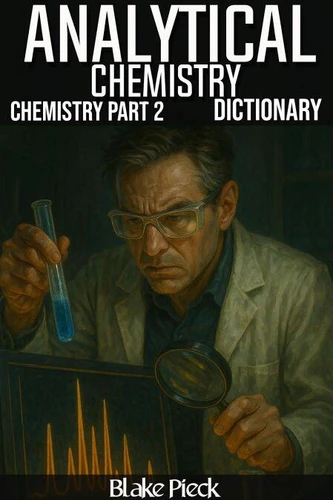
Analytical Chemistry - Chemistry Part 2 Dictionary. Grow Your Vocabulary
Par :Formats :
Disponible dans votre compte client Decitre ou Furet du Nord dès validation de votre commande. Le format ePub est :
- Compatible avec une lecture sur My Vivlio (smartphone, tablette, ordinateur)
- Compatible avec une lecture sur liseuses Vivlio
- Pour les liseuses autres que Vivlio, vous devez utiliser le logiciel Adobe Digital Edition. Non compatible avec la lecture sur les liseuses Kindle, Remarkable et Sony
 , qui est-ce ?
Notre partenaire de plateforme de lecture numérique où vous retrouverez l'ensemble de vos ebooks gratuitement
Pour en savoir plus sur nos ebooks, consultez notre aide en ligne ici
C'est si simple ! Lisez votre ebook avec l'app Vivlio sur votre tablette, mobile ou ordinateur :

- FormatePub
- ISBN8231665853
- EAN9798231665853
- Date de parution01/09/2025
- Protection num.pas de protection
- Infos supplémentairesepub
- ÉditeurWalzone Press
Résumé
Analytical chemistry is the study of how substances can be identified, measured, and understood through precise observation and methodical testing. It addresses the techniques that separate mixtures, determine concentrations, and reveal structures at the molecular level. From food safety inspections to forensic investigations, analytical science provides the tools to uncover the hidden details of matter.
Within the broader field of chemistry, analytical methods form the backbone of research and application. Every branch of chemical science relies on accurate measurement, whether in environmental monitoring, pharmaceutical development, or materials engineering. By mastering analytical principles, students and professionals can trace the path from raw data to scientific discovery, linking theoretical knowledge with practical outcomes.
This dictionary organizes the essential terminology of analytical chemistry into clear and comprehensive entries. Readers will find definitions that explore both classical methods, such as titration and gravimetry, and modern approaches, including spectroscopy, chromatography, and electrochemical analysis. Each entry is presented with context and depth, making it a dependable reference for learners, educators, and practitioners alike.
Studying through a structured dictionary builds familiarity with the precise language of science and strengthens the ability to apply concepts across disciplines. Such resources encourage both focused learning and broader exploration, helping readers to recognize the importance of measurement and analysis in shaping modern chemistry. A command of this vocabulary ensures a strong foundation for further study, research, and professional advancement in the chemical sciences.
Within the broader field of chemistry, analytical methods form the backbone of research and application. Every branch of chemical science relies on accurate measurement, whether in environmental monitoring, pharmaceutical development, or materials engineering. By mastering analytical principles, students and professionals can trace the path from raw data to scientific discovery, linking theoretical knowledge with practical outcomes.
This dictionary organizes the essential terminology of analytical chemistry into clear and comprehensive entries. Readers will find definitions that explore both classical methods, such as titration and gravimetry, and modern approaches, including spectroscopy, chromatography, and electrochemical analysis. Each entry is presented with context and depth, making it a dependable reference for learners, educators, and practitioners alike.
Studying through a structured dictionary builds familiarity with the precise language of science and strengthens the ability to apply concepts across disciplines. Such resources encourage both focused learning and broader exploration, helping readers to recognize the importance of measurement and analysis in shaping modern chemistry. A command of this vocabulary ensures a strong foundation for further study, research, and professional advancement in the chemical sciences.
A propos de Blake Pieck











17,49 €