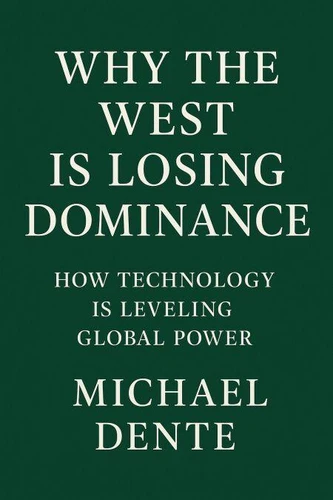
Why the West Is Losing Dominance: How Technology Is Leveling Global Power
Par :Formats :
Disponible dans votre compte client Decitre ou Furet du Nord dès validation de votre commande. Le format ePub est :
- Compatible avec une lecture sur My Vivlio (smartphone, tablette, ordinateur)
- Compatible avec une lecture sur liseuses Vivlio
- Pour les liseuses autres que Vivlio, vous devez utiliser le logiciel Adobe Digital Edition. Non compatible avec la lecture sur les liseuses Kindle, Remarkable et Sony
 , qui est-ce ?
Notre partenaire de plateforme de lecture numérique où vous retrouverez l'ensemble de vos ebooks gratuitement
Pour en savoir plus sur nos ebooks, consultez notre aide en ligne ici
C'est si simple ! Lisez votre ebook avec l'app Vivlio sur votre tablette, mobile ou ordinateur :

- FormatePub
- ISBN8232735821
- EAN9798232735821
- Date de parution10/12/2025
- Protection num.pas de protection
- Infos supplémentairesepub
- ÉditeurDraft2Digital
Résumé
For almost three hundred years, the Western world-first Europe, then the United States-stood at the center of global power. Its factories fueled the world economy, its technologies shaped modern life, its institutions set international norms, and its narratives defined how the world saw itself. But in the 21st century, this automatic dominance has faded. Not because the West collapsed, but because the world changed.
Why the West Is Losing Dominance offers a clear, compelling explanation of this global shift. The book traces the historical foundations of Western power, from the Industrial Revolution to the financial and technological monopolies that shaped the modern era. It then reveals how these monopolies have weakened as Asia rises, Africa grows, the Middle East transforms, and Latin America asserts itself.
At the same time, internal pressures-aging populations, economic strain, political fragmentation-challenge the West's ability to operate as it once did. Meanwhile, drones, AI, cyber capability, and digital sovereignty allow smaller nations to wield influence that was once unimaginable. Cultural and narrative power has also decentralized; information now flows through many centers, not one. This is the story of how projection became negotiation, how dominance gave way to multipolarity, and how technology leveled the field.
But this book is not about decline-it is about transformation. The West still holds immense strengths, and its future role depends not on reclaiming a lost era but on reinventing itself through innovation, cooperation, and adaptability. In a world where influence is shared and capability is widespread, the nations that thrive will be those that evolve. Power isn't dying. It's redistributing. And the world that emerges will be shaped by many hands, not just one.
Perfect for readers of geopolitics, economics, global strategy, and anyone seeking a grounded understanding of the emerging world order.
Why the West Is Losing Dominance offers a clear, compelling explanation of this global shift. The book traces the historical foundations of Western power, from the Industrial Revolution to the financial and technological monopolies that shaped the modern era. It then reveals how these monopolies have weakened as Asia rises, Africa grows, the Middle East transforms, and Latin America asserts itself.
At the same time, internal pressures-aging populations, economic strain, political fragmentation-challenge the West's ability to operate as it once did. Meanwhile, drones, AI, cyber capability, and digital sovereignty allow smaller nations to wield influence that was once unimaginable. Cultural and narrative power has also decentralized; information now flows through many centers, not one. This is the story of how projection became negotiation, how dominance gave way to multipolarity, and how technology leveled the field.
But this book is not about decline-it is about transformation. The West still holds immense strengths, and its future role depends not on reclaiming a lost era but on reinventing itself through innovation, cooperation, and adaptability. In a world where influence is shared and capability is widespread, the nations that thrive will be those that evolve. Power isn't dying. It's redistributing. And the world that emerges will be shaped by many hands, not just one.
Perfect for readers of geopolitics, economics, global strategy, and anyone seeking a grounded understanding of the emerging world order.