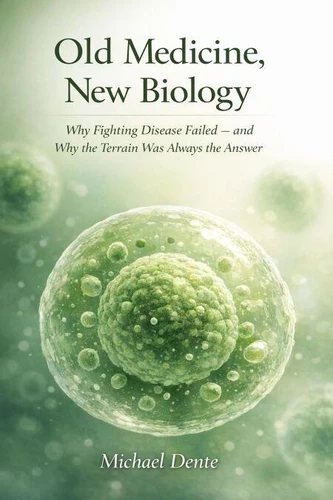
Old Medicine, New Biology: Why Fighting Disease Failed — and Why the Terrain Was Always the Answer
Par :Formats :
Disponible dans votre compte client Decitre ou Furet du Nord dès validation de votre commande. Le format ePub est :
- Compatible avec une lecture sur My Vivlio (smartphone, tablette, ordinateur)
- Compatible avec une lecture sur liseuses Vivlio
- Pour les liseuses autres que Vivlio, vous devez utiliser le logiciel Adobe Digital Edition. Non compatible avec la lecture sur les liseuses Kindle, Remarkable et Sony
 , qui est-ce ?
Notre partenaire de plateforme de lecture numérique où vous retrouverez l'ensemble de vos ebooks gratuitement
Pour en savoir plus sur nos ebooks, consultez notre aide en ligne ici
C'est si simple ! Lisez votre ebook avec l'app Vivlio sur votre tablette, mobile ou ordinateur :

- FormatePub
- ISBN8231952793
- EAN9798231952793
- Date de parution16/12/2025
- Protection num.pas de protection
- Infos supplémentairesepub
- ÉditeurWalzone Press
Résumé
Modern medicine has achieved extraordinary success. Infectious disease control, emergency care, surgical precision, and pharmaceutical innovation have transformed human survival. Yet despite these advances, chronic illness now dominates healthcare worldwide. Autoimmune conditions, metabolic disease, cardiovascular disorders, chronic inflammation, and persistent multisystem dysfunction continue to rise-often managed, but rarely resolved.
This book examines why. Rather than framing medicine as broken or misguided, [Book Title] explores the limits of a single explanatory model and the necessity of integrating multiple biological perspectives. It clarifies how germ theory, while indispensable in acute and infectious contexts, cannot fully account for the persistence, variability, and recurrence of modern chronic disease. Alongside it, terrain-based and systems-oriented approaches offer critical insight into how internal conditions-energy regulation, immune balance, cellular environment, and recovery capacity-shape health outcomes.
Written in a measured, evidence-informed tone, this book does not argue against modern medicine. It examines how medicine evolved, why certain approaches became dominant, and where those approaches now encounter structural limits. It distinguishes clearly between intervention and regulation, suppression and healing, causation and context. Key themes include: Why chronic disease challenges reductionist explanations How internal biological conditions influence susceptibility and recovery The role of microbes within healthy and disturbed systems Why symptoms often reflect regulatory strain rather than failure How healing unfolds as a process of functional restoration What an integrated future of medicine requires-from clinicians and institutions alike Avoiding ideology, speculation, and prescriptive advice, this work is intended for readers seeking clarity rather than controversy.
It speaks to clinicians, health professionals, students, and thoughtful general readers interested in the evolving understanding of biology, medicine, and health. The future of medicine is not a rejection of past success. It is an expansion-one that integrates intervention with regulation, precision with context, and treatment with long-term resilience.
This book examines why. Rather than framing medicine as broken or misguided, [Book Title] explores the limits of a single explanatory model and the necessity of integrating multiple biological perspectives. It clarifies how germ theory, while indispensable in acute and infectious contexts, cannot fully account for the persistence, variability, and recurrence of modern chronic disease. Alongside it, terrain-based and systems-oriented approaches offer critical insight into how internal conditions-energy regulation, immune balance, cellular environment, and recovery capacity-shape health outcomes.
Written in a measured, evidence-informed tone, this book does not argue against modern medicine. It examines how medicine evolved, why certain approaches became dominant, and where those approaches now encounter structural limits. It distinguishes clearly between intervention and regulation, suppression and healing, causation and context. Key themes include: Why chronic disease challenges reductionist explanations How internal biological conditions influence susceptibility and recovery The role of microbes within healthy and disturbed systems Why symptoms often reflect regulatory strain rather than failure How healing unfolds as a process of functional restoration What an integrated future of medicine requires-from clinicians and institutions alike Avoiding ideology, speculation, and prescriptive advice, this work is intended for readers seeking clarity rather than controversy.
It speaks to clinicians, health professionals, students, and thoughtful general readers interested in the evolving understanding of biology, medicine, and health. The future of medicine is not a rejection of past success. It is an expansion-one that integrates intervention with regulation, precision with context, and treatment with long-term resilience.