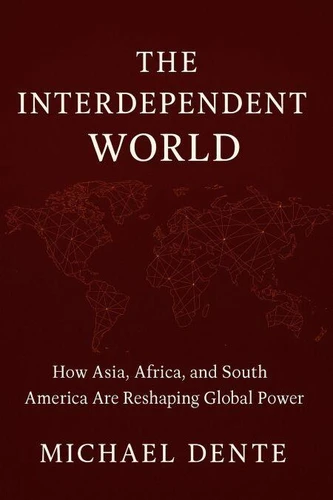
From Dependence to Interdependence The Future Geopolitics of Asia, Africa, and South America
Par :Formats :
Disponible dans votre compte client Decitre ou Furet du Nord dès validation de votre commande. Le format ePub est :
- Compatible avec une lecture sur My Vivlio (smartphone, tablette, ordinateur)
- Compatible avec une lecture sur liseuses Vivlio
- Pour les liseuses autres que Vivlio, vous devez utiliser le logiciel Adobe Digital Edition. Non compatible avec la lecture sur les liseuses Kindle, Remarkable et Sony
 , qui est-ce ?
Notre partenaire de plateforme de lecture numérique où vous retrouverez l'ensemble de vos ebooks gratuitement
Pour en savoir plus sur nos ebooks, consultez notre aide en ligne ici
C'est si simple ! Lisez votre ebook avec l'app Vivlio sur votre tablette, mobile ou ordinateur :

- FormatePub
- ISBN8232343019
- EAN9798232343019
- Date de parution15/12/2025
- Protection num.pas de protection
- Infos supplémentairesepub
- ÉditeurDraft2Digital
Résumé
The Future Geopolitics of Asia, Africa, and South AmericaFor much of the modern era, global geopolitics was structured through dependence. Energy systems, financial flows, trade routes, and institutional frameworks concentrated power in a small number of centers while distributing risk and constraint elsewhere. Stability was maintained not primarily through force, but through abstraction-markets, metrics, and agreements that allowed power to be exercised at a distance.
That structure is now breaking down. As energy shifts from fuels to systems, and infrastructure replaces resources as the primary source of influence, dependence becomes increasingly fragile. Power can no longer rely on narrative, institutional mediation, or delayed consequence. It must reconcile directly with physical systems, geography, and performance under load. From Dependence to Interdependence examines this structural transition and its geopolitical implications for Asia, Africa, and South America.
Rather than framing global change as rivalry or decline, the book explains why interdependence emerges as a functional response to tightly coupled systems-where risk cannot be externalized indefinitely and stability depends on shared infrastructure. The book explores how regions long shaped by extraction, commodity cycles, and externally mediated development are repositioning themselves through energy systems, corridors, and selective integration.
Instead of replacing one hierarchy with another, these regions are embedding agency within systems that distribute consequence, constrain excess, and reward reliability. This is not a book about ideology or prediction. It is a systems-level analysis of how power reorganizes when abstraction reaches its limits and infrastructure becomes decisive. Written for readers interested in geopolitics, energy, infrastructure, and global systems, From Dependence to Interdependence provides a framework for understanding why the global order is changing unevenly, rapidly, and often on the fly-and why these changes are structural rather than temporary.
In an interdependent world, power persists. What changes is how it is exercised.
That structure is now breaking down. As energy shifts from fuels to systems, and infrastructure replaces resources as the primary source of influence, dependence becomes increasingly fragile. Power can no longer rely on narrative, institutional mediation, or delayed consequence. It must reconcile directly with physical systems, geography, and performance under load. From Dependence to Interdependence examines this structural transition and its geopolitical implications for Asia, Africa, and South America.
Rather than framing global change as rivalry or decline, the book explains why interdependence emerges as a functional response to tightly coupled systems-where risk cannot be externalized indefinitely and stability depends on shared infrastructure. The book explores how regions long shaped by extraction, commodity cycles, and externally mediated development are repositioning themselves through energy systems, corridors, and selective integration.
Instead of replacing one hierarchy with another, these regions are embedding agency within systems that distribute consequence, constrain excess, and reward reliability. This is not a book about ideology or prediction. It is a systems-level analysis of how power reorganizes when abstraction reaches its limits and infrastructure becomes decisive. Written for readers interested in geopolitics, energy, infrastructure, and global systems, From Dependence to Interdependence provides a framework for understanding why the global order is changing unevenly, rapidly, and often on the fly-and why these changes are structural rather than temporary.
In an interdependent world, power persists. What changes is how it is exercised.