- Accueil /
- Michael Dente
Michael Dente

Dernière sortie
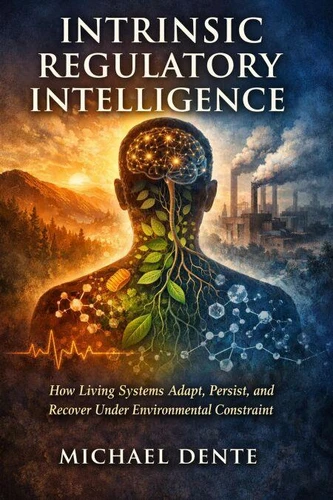
Intrinsic Regulatory Intelligence: How Living Systems Adapt, Persist, and Recover Under Environmental Constraint
This book describes how living systems regulate themselves internally and why recovery, reversal, and failure follow predictable biological constraints rather than intention, belief, or intervention alone. Modern health, environmental, and recovery frameworks often assume that improvement in external conditions leads directly to restoration of function. This assumption fails when environments persist long enough to be internalized.
Under sustained constraint, biological systems reorganize their regulatory priorities to preserve continuity. That reorganization does not automatically reverse when conditions change. Across multiple regulatory domains, this book traces how intrinsic regulatory intelligence adapts to persistent signal load, accumulates unresolved regulatory cycles, and establishes conservative internal decision rules.
It explains why relief frequently precedes relapse, why time alone does not restore function, and why reversal requires specific conditions that exceed historical thresholds. The analysis focuses on internal mechanisms rather than outcomes: regulatory lag, resolution debt, energetic constraints, signal coherence, and confidence-based reversal. It distinguishes structural recovery from superficial improvement and describes how systems reopen reversal pathways once persistence has stabilized.
No prescriptions are offered. The book documents what follows when biological regulation is treated as intrinsic, history-dependent, and conservative under uncertainty.
Under sustained constraint, biological systems reorganize their regulatory priorities to preserve continuity. That reorganization does not automatically reverse when conditions change. Across multiple regulatory domains, this book traces how intrinsic regulatory intelligence adapts to persistent signal load, accumulates unresolved regulatory cycles, and establishes conservative internal decision rules.
It explains why relief frequently precedes relapse, why time alone does not restore function, and why reversal requires specific conditions that exceed historical thresholds. The analysis focuses on internal mechanisms rather than outcomes: regulatory lag, resolution debt, energetic constraints, signal coherence, and confidence-based reversal. It distinguishes structural recovery from superficial improvement and describes how systems reopen reversal pathways once persistence has stabilized.
No prescriptions are offered. The book documents what follows when biological regulation is treated as intrinsic, history-dependent, and conservative under uncertainty.
This book describes how living systems regulate themselves internally and why recovery, reversal, and failure follow predictable biological constraints rather than intention, belief, or intervention alone. Modern health, environmental, and recovery frameworks often assume that improvement in external conditions leads directly to restoration of function. This assumption fails when environments persist long enough to be internalized.
Under sustained constraint, biological systems reorganize their regulatory priorities to preserve continuity. That reorganization does not automatically reverse when conditions change. Across multiple regulatory domains, this book traces how intrinsic regulatory intelligence adapts to persistent signal load, accumulates unresolved regulatory cycles, and establishes conservative internal decision rules.
It explains why relief frequently precedes relapse, why time alone does not restore function, and why reversal requires specific conditions that exceed historical thresholds. The analysis focuses on internal mechanisms rather than outcomes: regulatory lag, resolution debt, energetic constraints, signal coherence, and confidence-based reversal. It distinguishes structural recovery from superficial improvement and describes how systems reopen reversal pathways once persistence has stabilized.
No prescriptions are offered. The book documents what follows when biological regulation is treated as intrinsic, history-dependent, and conservative under uncertainty.
Under sustained constraint, biological systems reorganize their regulatory priorities to preserve continuity. That reorganization does not automatically reverse when conditions change. Across multiple regulatory domains, this book traces how intrinsic regulatory intelligence adapts to persistent signal load, accumulates unresolved regulatory cycles, and establishes conservative internal decision rules.
It explains why relief frequently precedes relapse, why time alone does not restore function, and why reversal requires specific conditions that exceed historical thresholds. The analysis focuses on internal mechanisms rather than outcomes: regulatory lag, resolution debt, energetic constraints, signal coherence, and confidence-based reversal. It distinguishes structural recovery from superficial improvement and describes how systems reopen reversal pathways once persistence has stabilized.
No prescriptions are offered. The book documents what follows when biological regulation is treated as intrinsic, history-dependent, and conservative under uncertainty.
Les livres de Michael Dente

4,49 €

2,99 €

2,99 €

4,49 €

4,49 €

2,99 €


2,99 €

2,99 €

4,49 €

4,49 €

2,99 €

4,49 €

4,49 €

4,49 €

4,49 €

8,99 €

2,99 €

7,99 €