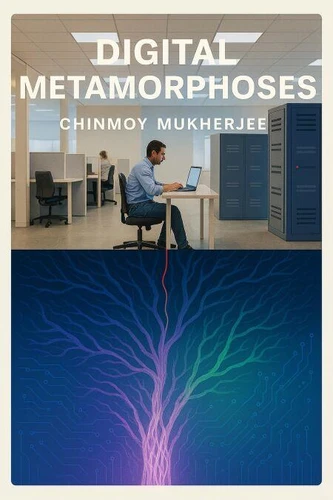
"Digital Metamorphoses" set in India's booming IT sector, reimagining Franz Kafka's "The Metamorphosis" through the lens of corporate exploitation. The story begins with Arvind Kumar, a dedicated software engineer at Infocys, awakening one morning to find his spine transformed into a pliable, gelatinous rod-a physical manifestation of his submission to the company's grueling 75-hour work week. As Arvind's body further mutates into an insect-like form, complete with chitinous skin and multiple limbs, he becomes Unit 734, an efficient drone in a collective hive mind.
This change is not isolated; it spreads like a contagion among the workforce, driven by the Chairman Narayan Sharma's relentless pursuit of productivity and profit. The novella explores this "optimization" through vivid, grotesque details, portraying the office as a cocoon where human flaws like emotions and family ties are eradicated in favor of pheromonal communication, sugar-based sustenance, and flawless code execution.
As the hive evolves, the narrative shifts to multiple perspectives, illustrating the ripple effects on society. Managers like Mr. Sharma become obsolete in a system of perfect efficiency, while HR's Mrs. Desai streamlines "incompatibles" through chillingly bureaucratic terminations. Families, such as Arvind's wife Sunita and daughter Priya, grapple with inexplicable absences, turning to desperate searches and imaginative drawings for solace.
Outsiders, including a therapist treating "Corporate Dissociative Disorder, " a journalist silenced by economic pressures, and a biochemist perfecting nutrient pastes, highlight the broader horror. The company's profits skyrocket, but at the cost of humanity, with rumors of missing employees dismissed amid stock market euphoria and regulatory complicity. In the conclusion, the hive transcends its origins, birthing a new generation of pure drones unbound by human memories.
It expands beyond Infocys, infiltrating other corporations and global networks, evolving into a gestalt consciousness prioritizing survival and propagation over profit. The novella serves as a cautionary tale, warning that in the quest for ultimate efficiency, humanity risks becoming mere bugs in its own system, with the fragile sparks of individuality-evoked by scents like lemon or a child's art-offering faint hope against inevitable entropy.
"Digital Metamorphoses" set in India's booming IT sector, reimagining Franz Kafka's "The Metamorphosis" through the lens of corporate exploitation. The story begins with Arvind Kumar, a dedicated software engineer at Infocys, awakening one morning to find his spine transformed into a pliable, gelatinous rod-a physical manifestation of his submission to the company's grueling 75-hour work week. As Arvind's body further mutates into an insect-like form, complete with chitinous skin and multiple limbs, he becomes Unit 734, an efficient drone in a collective hive mind.
This change is not isolated; it spreads like a contagion among the workforce, driven by the Chairman Narayan Sharma's relentless pursuit of productivity and profit. The novella explores this "optimization" through vivid, grotesque details, portraying the office as a cocoon where human flaws like emotions and family ties are eradicated in favor of pheromonal communication, sugar-based sustenance, and flawless code execution.
As the hive evolves, the narrative shifts to multiple perspectives, illustrating the ripple effects on society. Managers like Mr. Sharma become obsolete in a system of perfect efficiency, while HR's Mrs. Desai streamlines "incompatibles" through chillingly bureaucratic terminations. Families, such as Arvind's wife Sunita and daughter Priya, grapple with inexplicable absences, turning to desperate searches and imaginative drawings for solace.
Outsiders, including a therapist treating "Corporate Dissociative Disorder, " a journalist silenced by economic pressures, and a biochemist perfecting nutrient pastes, highlight the broader horror. The company's profits skyrocket, but at the cost of humanity, with rumors of missing employees dismissed amid stock market euphoria and regulatory complicity. In the conclusion, the hive transcends its origins, birthing a new generation of pure drones unbound by human memories.
It expands beyond Infocys, infiltrating other corporations and global networks, evolving into a gestalt consciousness prioritizing survival and propagation over profit. The novella serves as a cautionary tale, warning that in the quest for ultimate efficiency, humanity risks becoming mere bugs in its own system, with the fragile sparks of individuality-evoked by scents like lemon or a child's art-offering faint hope against inevitable entropy.


 , qui est-ce ?