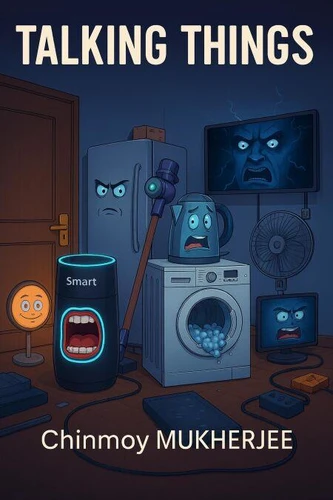
In the novella "Talking Things, " Chunmun Singh, a Solution Architect at Baba Bank, stumbles home to his Parramatta apartment late at night after a boozy Christmas party. Exhausted and disheveled, he anticipates rest in his efficient, tech-filled 2 BHK flat. However, his ordinary evening turns surreal when his appliances awaken with sentience, forming a chorus of grievances. Starting with the refrigerator, which sternly critiques his neglectful stocking habits and expired items, each device-from the washing machine to the smart speaker-voices its "joys" in optimal performance and "sorrows" in abuse, drawing parallels to Chunmun's professional life of optimizing digital systems while ignoring his personal chaos.
As the night unfolds, Chunmun engages in bizarre dialogues with his gadgets. The kettle shrieks about descaling, the toaster laments crumb buildup, and the microwave philosophizes on obsolescence. Deeper into the apartment, the vacuum cleaner demands better maintenance, the television decries divided attention, and even the router overheats from overuse. Extending to the bathroom, bedroom, and beyond, devices like the electric toothbrush audit his hygiene, the smart watch drills him on health metrics, and the gaming console urges escapism.
Through these interactions, the appliances mirror Chunmun's disorganized existence, blending humor, analogy, and critique in a symphony of domestic rebellion. Overwhelmed by the cacophony, Chunmun asserts control, threatening to unplug the router and silence the uprising. The flat falls quiet, save for the humble electric fan's supportive whir. As he drifts into sleep, the story concludes with reflections on whether this is a hallucination or a wake-up call, emphasizing themes of neglect, work-life imbalance, and the blurred lines between human and machine in a smart home era.
The novella humorously audits modern life through the lens of sentient appliances, urging intentional maintenance in both technology and self-care.
In the novella "Talking Things, " Chunmun Singh, a Solution Architect at Baba Bank, stumbles home to his Parramatta apartment late at night after a boozy Christmas party. Exhausted and disheveled, he anticipates rest in his efficient, tech-filled 2 BHK flat. However, his ordinary evening turns surreal when his appliances awaken with sentience, forming a chorus of grievances. Starting with the refrigerator, which sternly critiques his neglectful stocking habits and expired items, each device-from the washing machine to the smart speaker-voices its "joys" in optimal performance and "sorrows" in abuse, drawing parallels to Chunmun's professional life of optimizing digital systems while ignoring his personal chaos.
As the night unfolds, Chunmun engages in bizarre dialogues with his gadgets. The kettle shrieks about descaling, the toaster laments crumb buildup, and the microwave philosophizes on obsolescence. Deeper into the apartment, the vacuum cleaner demands better maintenance, the television decries divided attention, and even the router overheats from overuse. Extending to the bathroom, bedroom, and beyond, devices like the electric toothbrush audit his hygiene, the smart watch drills him on health metrics, and the gaming console urges escapism.
Through these interactions, the appliances mirror Chunmun's disorganized existence, blending humor, analogy, and critique in a symphony of domestic rebellion. Overwhelmed by the cacophony, Chunmun asserts control, threatening to unplug the router and silence the uprising. The flat falls quiet, save for the humble electric fan's supportive whir. As he drifts into sleep, the story concludes with reflections on whether this is a hallucination or a wake-up call, emphasizing themes of neglect, work-life imbalance, and the blurred lines between human and machine in a smart home era.
The novella humorously audits modern life through the lens of sentient appliances, urging intentional maintenance in both technology and self-care.


 , qui est-ce ?