

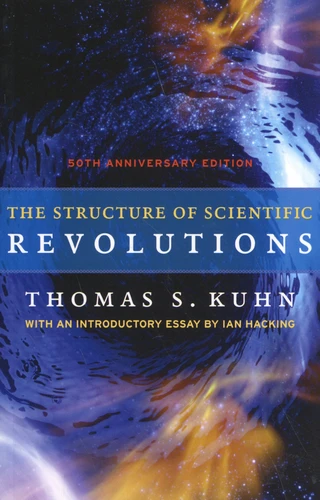
The Structure of Scientific Revolutions
4th edition
Par : Formats :
Actuellement indisponible
Cet article est actuellement indisponible, il ne peut pas être commandé sur notre site pour le moment. Nous vous invitons à vous inscrire à l'alerte disponibilité, vous recevrez un e-mail dès que cet ouvrage sera à nouveau disponible.
- Nombre de pages217
- PrésentationBroché
- Poids0.36 kg
- Dimensions14,0 cm × 21,5 cm × 2,0 cm
- ISBN978-0-226-45812-0
- EAN9780226458120
- Date de parution01/05/2012
- ÉditeurUniversity of Chicago Press
- PréfacierIan Hacking
Résumé
When it was first published in 1962, The Structure of Scientific Revolutions was a landmark event in the history and philosophy of science. Fifty years later, it still has many lessons to teach. With The Structure of Scientific Revolutions, Thomas S. Kuhn challenged long-standing linear notions of Scientific progress, arguing that transformative ideas do not arise from the day-to-day, gradual process of experimentation and data accumulation, but that the revolutions in science, those breakthrough moments that disrupt accepted thinking and offer unanticipated ideas, occur outside of "normal science," as he called it.
Though Kuhn was writing when physics ruled the sciences, his ideas on how scientific revolutions bring order to the anomalies that amass over time in research experiments are still instructive in our biotech age. This new edition of Kuhn's essential work in the history of science includes an insightful introduction by Ian Hacking, which clarifies terms popularized by Kuhn, including paradigm and incommensurability, and applies Kuhn's ideas to the science of today.
Though Kuhn was writing when physics ruled the sciences, his ideas on how scientific revolutions bring order to the anomalies that amass over time in research experiments are still instructive in our biotech age. This new edition of Kuhn's essential work in the history of science includes an insightful introduction by Ian Hacking, which clarifies terms popularized by Kuhn, including paradigm and incommensurability, and applies Kuhn's ideas to the science of today.
A propos de Thomas Samuel Kuhn



Vous aimerez aussi

Si Einstein avait su...
Grand Format
24,90 €

Courts-circuits
Poche
9,00 €

19,95 €

3,90 €

La vie à portée de main
Grand Format
22,90 €

Les maths sont un tango à trois temps
Grand Format
21,50 €