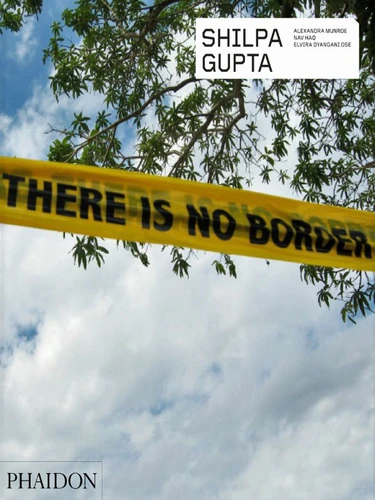
Shilpa Gupta is a visual artist interested in exploring some of the most everyday - and as such, relatable - aspects of human experience, and in unravelling assumptions normally associated with them. Through the use of a variety of materials and media, including found objects, sound, sculpture, photography, interactive installation, and performance, her work reveals how our own thought patterns, the nature of the world in which we live, and the possibilities opened up by technology can affect our decision making and ideas.
Gupta's focus on both the life of the individual and the nature of society in general is translated into works that address gender and class inequalities, religious differences, and geo-political barriers, highlighting the seductive power encouraged by today's media of a common public consensus. Presented in an intimate and poetic way, her examination of these invisible but enduring themes, which both separate and bind together various facets of contemporary society, results in pieces that quietly challenge her audience - often sensorially - to see things from a viewpoint traditionally reserved to those regarded as outside the norm, and to initiate a process of empathetic understanding.
Shilpa Gupta was born in Mumbai in 1976, where she lives and works. From 1992 to 1997 she studied sculpture at the Sir J. J. School of Fine Arts. The lack of platforms on which to exhibit her work, and her search for new relationships and audiences, led her to pioneer internet art as well as to conceive exhibitions and explore diverse forms of sharing, including the groundbreaking series Aar-Paar (2000), where she and fellow artist Huma Mulji organized an exchange project between India and Pakistan, and the volume on imprisoned poets co-edited with writer Salil Tripathi.
Gupta has had solo shows at some of the most prestigious venues around the world, including the Barbican Art Centre in London, Dallas Contemporary, Museum voor Moderne Kunst in Arnhem, OK Center for Contemporary Art in Linz, Contemporary Arts Center in Cincinnati, and Arnolfini in Bristol. She has participated in biennales in Venice, Berlin, Kochi, Lyon, Gwangju, Havana, Liverpool, Sydney, and Yokohama amongst others.
Her work has also been exhibited at the Museum of Modern Art, New York, Tate Modern, London, Centre Pompidou, Paris, Solomon R. Guggenheim Museum, New York, and Mori Museum, Tokyo. In the Interview the artist talks to ALEXANDRA MUNROE about the struggles and difficulties she encountered at the beginning of her career, and how her drive to denounce and tackle these issues eventually helped her to overcome them.
NAV HAQ's survey text is a generous account of how Gupta's twenty-five-year practice came about, from her early days in India to her international breakthrough. In the Focus, ELVIRA DYANGANI OSE writes about For, In Your Tongue, I Cannot Fit, a multi-media installation presented at the 58th Venice Biennale in 2019, and one of Gupta's most iconic pieces. For ARTIST'S CHOICE, Gupta has selected an excerpt from famed academic Pratap Bhanu Mehta's essay 'Afterwords : A Brief History of Freedom' (2021).
ARTIST'S WRITINGS features the script of one of the artist's most language-oriented works, Notes for Today Will End (2021).
Shilpa Gupta is a visual artist interested in exploring some of the most everyday - and as such, relatable - aspects of human experience, and in unravelling assumptions normally associated with them. Through the use of a variety of materials and media, including found objects, sound, sculpture, photography, interactive installation, and performance, her work reveals how our own thought patterns, the nature of the world in which we live, and the possibilities opened up by technology can affect our decision making and ideas.
Gupta's focus on both the life of the individual and the nature of society in general is translated into works that address gender and class inequalities, religious differences, and geo-political barriers, highlighting the seductive power encouraged by today's media of a common public consensus. Presented in an intimate and poetic way, her examination of these invisible but enduring themes, which both separate and bind together various facets of contemporary society, results in pieces that quietly challenge her audience - often sensorially - to see things from a viewpoint traditionally reserved to those regarded as outside the norm, and to initiate a process of empathetic understanding.
Shilpa Gupta was born in Mumbai in 1976, where she lives and works. From 1992 to 1997 she studied sculpture at the Sir J. J. School of Fine Arts. The lack of platforms on which to exhibit her work, and her search for new relationships and audiences, led her to pioneer internet art as well as to conceive exhibitions and explore diverse forms of sharing, including the groundbreaking series Aar-Paar (2000), where she and fellow artist Huma Mulji organized an exchange project between India and Pakistan, and the volume on imprisoned poets co-edited with writer Salil Tripathi.
Gupta has had solo shows at some of the most prestigious venues around the world, including the Barbican Art Centre in London, Dallas Contemporary, Museum voor Moderne Kunst in Arnhem, OK Center for Contemporary Art in Linz, Contemporary Arts Center in Cincinnati, and Arnolfini in Bristol. She has participated in biennales in Venice, Berlin, Kochi, Lyon, Gwangju, Havana, Liverpool, Sydney, and Yokohama amongst others.
Her work has also been exhibited at the Museum of Modern Art, New York, Tate Modern, London, Centre Pompidou, Paris, Solomon R. Guggenheim Museum, New York, and Mori Museum, Tokyo. In the Interview the artist talks to ALEXANDRA MUNROE about the struggles and difficulties she encountered at the beginning of her career, and how her drive to denounce and tackle these issues eventually helped her to overcome them.
NAV HAQ's survey text is a generous account of how Gupta's twenty-five-year practice came about, from her early days in India to her international breakthrough. In the Focus, ELVIRA DYANGANI OSE writes about For, In Your Tongue, I Cannot Fit, a multi-media installation presented at the 58th Venice Biennale in 2019, and one of Gupta's most iconic pieces. For ARTIST'S CHOICE, Gupta has selected an excerpt from famed academic Pratap Bhanu Mehta's essay 'Afterwords : A Brief History of Freedom' (2021).
ARTIST'S WRITINGS features the script of one of the artist's most language-oriented works, Notes for Today Will End (2021).