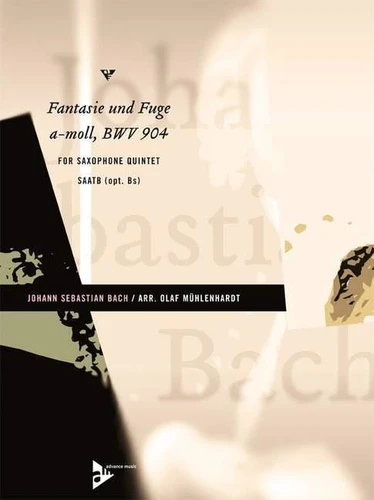
Fantasie and Fuge A minor. BWV 904. 5 saxophones (SAATBar (opt. B)). Partition et parties.
Par :Formats :
Actuellement indisponible
Cet article est actuellement indisponible, il ne peut pas être commandé sur notre site pour le moment. Nous vous invitons à vous inscrire à l'alerte disponibilité, vous recevrez un e-mail dès que cet ouvrage sera à nouveau disponible.
- Nombre de pages36
- Poids0.444 kg
- Dimensions23,1 cm × 30,3 cm × 0,0 cm
- ISBN978-3-89221-653-7
- EAN9783892216537
- Date de parution01/01/2009
- ÉditeurADVANCE
- MusicienOlaf Mühlenhardt
Résumé
Bach probably composed Fantasia and Fugue around 1725 at the beginning of his Leipzig years. Hardly any of his keyboard works is so closely associated with his organ works. The remarks ,manualiter' in two of the surviving manuscripts suggest that it was also played on the organ. The character of the Fantasia is serious and grave. Even the interludes, despite their lighter texture, maintain an overall contemplative character.
Its concerto form is strictly symmetrical. The main theme appears four times : in a-minor, e-minor, d-minor and finally a-minor. Three interludes often employ only three parts and effectively contrast the full harmony of the main theme. The four-part double fugue is an example of Bach's unique contrapuntal craftsmanship. He combines two notably contrasting themes : the first is diatonic, rhythmic and agile while the second consists of a descending chromatic line.
It appears around the center of the movement after a short cadence cesura. Surprisingly, it is immediately presented in stretto form. At the end both themes are combined three times. Instrumentation : 5 saxophones (SAATBar (opt. B)) BWV 904
Its concerto form is strictly symmetrical. The main theme appears four times : in a-minor, e-minor, d-minor and finally a-minor. Three interludes often employ only three parts and effectively contrast the full harmony of the main theme. The four-part double fugue is an example of Bach's unique contrapuntal craftsmanship. He combines two notably contrasting themes : the first is diatonic, rhythmic and agile while the second consists of a descending chromatic line.
It appears around the center of the movement after a short cadence cesura. Surprisingly, it is immediately presented in stretto form. At the end both themes are combined three times. Instrumentation : 5 saxophones (SAATBar (opt. B)) BWV 904
L'éditeur en parle
The character of the "Fantasie" is serious and grave ; even in the interludes a contemplative mood prevails. Its concerto form is strictly symmetrical : the main theme appears four times with three interludes between. The four-part double "Fugue" exemplifies Bach's contrapuntal craftsmanship as he combines two contrasting themes. Besetzung : 5 saxophones (SAATBar (opt. B)) BWV 904
A propos de Johann sebastian Bach
Vous aimerez aussi