

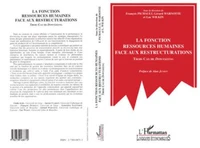
Change Management towards Polyphony. Case studies
Par :Formats :
- Paiement en ligne :
- Livraison à domicile ou en point Mondial Relay estimée à partir du 31 marsCet article sera commandé chez un fournisseur et vous sera envoyé 7 jours après la date de votre commande.
- Retrait Click and Collect en magasin gratuit
- Livraison à domicile ou en point Mondial Relay estimée à partir du 31 mars
- Réservation en ligne avec paiement en magasin :
- Indisponible pour réserver et payer en magasin
- Nombre de pages182
- FormatPoche
- PrésentationBroché
- Poids0.339 kg
- Dimensions17,5 cm × 24,0 cm × 0,5 cm
- ISBN978-2-8041-7673-0
- EAN9782804176730
- Date de parution05/09/2013
- CollectionManager RH
- ÉditeurDe Boeck
- PréfacierErhard Friedberg
Résumé
This book develops a critical view on the main current theories in change management and leads to a multidimensional grid for assessing change processes. Thanks to numerous case studies, it offers a concrete illustration of a polyphonic management style. This book develops a critical view on the main current theories in change management. Most of them offer partial explanations : the planning model considers change as a linear process, in which design necessarily precedes implementation ; the contingent model is essentially focussed on contextual pressures ; the political model is mainly concerned with power games, often leading to the dilution of change, etc.
The book proposes an original combination of these models by referring to the actor-network theory, a french sociologiclal perspective. Thanks to numerous case studies, it provides the reader with a rich and concrete understanding of the main phenomena linked to any change process. It leads to a multidimensional grid for assessing change processes and pleads for the adoption of a "polyphonic" management style, in which the interests of the various stakeholders concerned directly contribute to the design of the project.
The book proposes an original combination of these models by referring to the actor-network theory, a french sociologiclal perspective. Thanks to numerous case studies, it provides the reader with a rich and concrete understanding of the main phenomena linked to any change process. It leads to a multidimensional grid for assessing change processes and pleads for the adoption of a "polyphonic" management style, in which the interests of the various stakeholders concerned directly contribute to the design of the project.
A propos de François Pichault



24,90 €


24,00 €





Vous aimerez aussi




25,09 €


17,00 €