
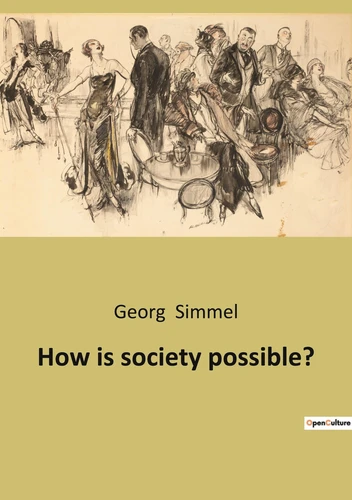
How is society possible?
Par :Formats :
- Paiement en ligne :
- Livraison à domicile ou en point Mondial Relay estimée à partir du 9 avrilCet article sera commandé chez un fournisseur et vous sera envoyé 21 jours après la date de votre commande.
- Retrait Click and Collect en magasin gratuit
- Livraison à domicile ou en point Mondial Relay estimée à partir du 9 avril
- Nombre de pages28
- PrésentationBroché
- Poids0.052 kg
- Dimensions14,8 cm × 21,0 cm × 0,2 cm
- ISBN979-10-419-4102-5
- EAN9791041941025
- Date de parution19/12/2022
- ÉditeurCulturea
Résumé
Georg Simmel's essay "How Is Society Possible ? " is built on the idea that an individual can develop himself or herself fully only by entering into society but nevertheless remains marked with an "in-addition" or "individuality-nucleus" that is never entirely socialized. Georg Simmel, American Journal of Sociology, vol. 16 (1910-11) "Kant could propose and answer the fundamental question of his philosophy, How is nature possible ? , only because for him nature was nothing but the representation (Vorstellung) of nature.
This does not mean merely that "the world is my representation, " that we thus can speak of nature only so far as it is a content of our consciousness, but that what we call nature is a special way in which our intellect assembles, orders, and forms the sense perceptions. These "given" perceptions, of color, taste, tone, temperature, resistance, smell, which in the accidental sequence of subjective experience course through our consciousness, are in and of themselves not yet "nature ; " but they become "nature" through the activity of the mind, which combines them into objects and series of objects, into substances and attributes and into causal coherences".
This does not mean merely that "the world is my representation, " that we thus can speak of nature only so far as it is a content of our consciousness, but that what we call nature is a special way in which our intellect assembles, orders, and forms the sense perceptions. These "given" perceptions, of color, taste, tone, temperature, resistance, smell, which in the accidental sequence of subjective experience course through our consciousness, are in and of themselves not yet "nature ; " but they become "nature" through the activity of the mind, which combines them into objects and series of objects, into substances and attributes and into causal coherences".
A propos de Georg Simmel

9,70 €
12,00 €
7,00 €
4/5
Philosophie de l'argent
3e édition
3e édition
Grand Format
23,00 €
7,00 €
Philosophie de la religion
Grand Format
9,00 €

7,20 €

3,87 €
9,99 €
Kant und Goethe
E-book
9,99 €