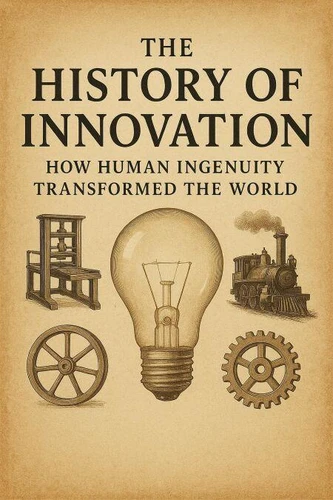
The History of Innovation: How Human Ingenuity Transformed the World
Par :Formats :
Disponible dans votre compte client Decitre ou Furet du Nord dès validation de votre commande. Le format ePub est :
- Compatible avec une lecture sur My Vivlio (smartphone, tablette, ordinateur)
- Compatible avec une lecture sur liseuses Vivlio
- Pour les liseuses autres que Vivlio, vous devez utiliser le logiciel Adobe Digital Edition. Non compatible avec la lecture sur les liseuses Kindle, Remarkable et Sony
 , qui est-ce ?
Notre partenaire de plateforme de lecture numérique où vous retrouverez l'ensemble de vos ebooks gratuitement
Pour en savoir plus sur nos ebooks, consultez notre aide en ligne ici
C'est si simple ! Lisez votre ebook avec l'app Vivlio sur votre tablette, mobile ou ordinateur :

- FormatePub
- ISBN8232994662
- EAN9798232994662
- Date de parution27/11/2025
- Protection num.pas de protection
- Infos supplémentairesepub
- ÉditeurDraft2Digital
Résumé
This comprehensive exploration traces humanity's remarkable journey from the first controlled flames to the algorithms that shape modern life, revealing how innovation has been the defining characteristic of human progress across millennia. Through twenty-five meticulously researched chapters, the book demonstrates that innovation is not merely a sequence of isolated inventions but a continuous, interconnected process whereby each breakthrough builds upon previous discoveries to expand the boundaries of human possibility.
Beginning with the dawn of human achievement, the narrative examines foundational innovations that fundamentally altered the human condition: the mastery of fire, which extended day into night and transformed nutrition; the crafting of stone tools, which amplified human capability and established patterns of cumulative learning; and the Agricultural Revolution, which enabled settled communities and surplus production.
These early chapters establish that innovation arose not from individual genius alone but from communities observing, experimenting, and transmitting knowledge across generations. The book then explores how ancient civilizations-Mesopotamia, Egypt, Greece, Rome, and China-developed distinctive approaches to innovation shaped by their environments and values. Mesopotamia's irrigation systems and cuneiform writing show how managing complexity drove organizational and informational tools.
Egyptian engineering demonstrates the integration of technical skill with symbolic ambition in monuments that still inspire. Greek philosophy, mathematics, and democracy reveal innovation in thought itself, while Roman infrastructure illustrates the power of systematic implementation at scale. China's gifts-paper, printing, gunpowder, and the compass-underscore that innovation flourished across cultures, each contributing unique constellations of ideas.
Moving through the medieval period and Renaissance, the narrative tracks how innovations in agriculture, architecture, printing, and scientific method laid groundwork for modernity. The printing press democratized knowledge, while the Scientific Revolution established systematic empirical inquiry as humanity's most powerful tool for understanding nature. These intellectual transformations set the stage for the Industrial Revolution, where steam power, mechanized textile production, and advances in iron and steel fundamentally restructured economies and societies.
The later chapters chronicle the acceleration of innovation through railroads, mass production, electricity, electronics, and computing-each wave compressing time, expanding reach, and embedding technology more deeply into daily existence. The twentieth and twenty-first centuries witness innovation turning inward: biotechnology allows humanity to rewrite genetic codes, artificial intelligence begins to approximate cognitive functions, and wireless networks create a globally connected civilization operating at the speed of thought.
Throughout, the book maintains a balanced perspective, acknowledging both the extraordinary benefits and the profound costs of innovation. It explores how advances that liberate and empower can also exploit and exclude, how technologies designed to solve problems create new challenges, and how societies must continually negotiate the terms on which they adopt transformative capabilities. The narrative emphasizes that innovation is never purely technical; it is always embedded in social, economic, political, and ethical contexts that shape both its development and its consequences.
Beginning with the dawn of human achievement, the narrative examines foundational innovations that fundamentally altered the human condition: the mastery of fire, which extended day into night and transformed nutrition; the crafting of stone tools, which amplified human capability and established patterns of cumulative learning; and the Agricultural Revolution, which enabled settled communities and surplus production.
These early chapters establish that innovation arose not from individual genius alone but from communities observing, experimenting, and transmitting knowledge across generations. The book then explores how ancient civilizations-Mesopotamia, Egypt, Greece, Rome, and China-developed distinctive approaches to innovation shaped by their environments and values. Mesopotamia's irrigation systems and cuneiform writing show how managing complexity drove organizational and informational tools.
Egyptian engineering demonstrates the integration of technical skill with symbolic ambition in monuments that still inspire. Greek philosophy, mathematics, and democracy reveal innovation in thought itself, while Roman infrastructure illustrates the power of systematic implementation at scale. China's gifts-paper, printing, gunpowder, and the compass-underscore that innovation flourished across cultures, each contributing unique constellations of ideas.
Moving through the medieval period and Renaissance, the narrative tracks how innovations in agriculture, architecture, printing, and scientific method laid groundwork for modernity. The printing press democratized knowledge, while the Scientific Revolution established systematic empirical inquiry as humanity's most powerful tool for understanding nature. These intellectual transformations set the stage for the Industrial Revolution, where steam power, mechanized textile production, and advances in iron and steel fundamentally restructured economies and societies.
The later chapters chronicle the acceleration of innovation through railroads, mass production, electricity, electronics, and computing-each wave compressing time, expanding reach, and embedding technology more deeply into daily existence. The twentieth and twenty-first centuries witness innovation turning inward: biotechnology allows humanity to rewrite genetic codes, artificial intelligence begins to approximate cognitive functions, and wireless networks create a globally connected civilization operating at the speed of thought.
Throughout, the book maintains a balanced perspective, acknowledging both the extraordinary benefits and the profound costs of innovation. It explores how advances that liberate and empower can also exploit and exclude, how technologies designed to solve problems create new challenges, and how societies must continually negotiate the terms on which they adopt transformative capabilities. The narrative emphasizes that innovation is never purely technical; it is always embedded in social, economic, political, and ethical contexts that shape both its development and its consequences.
A propos de Aakash Agrawal



2,99 €

2,99 €