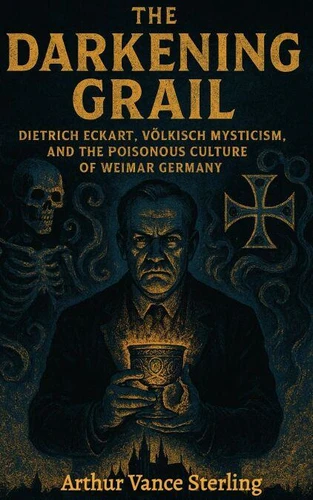
The Darkening Grail: Dietrich Eckart, Völkisch Mysticism, and the Poisonous Culture of Weimar Germany
Par :Formats :
Disponible dans votre compte client Decitre ou Furet du Nord dès validation de votre commande. Le format ePub est :
- Compatible avec une lecture sur My Vivlio (smartphone, tablette, ordinateur)
- Compatible avec une lecture sur liseuses Vivlio
- Pour les liseuses autres que Vivlio, vous devez utiliser le logiciel Adobe Digital Edition. Non compatible avec la lecture sur les liseuses Kindle, Remarkable et Sony
 , qui est-ce ?
Notre partenaire de plateforme de lecture numérique où vous retrouverez l'ensemble de vos ebooks gratuitement
Pour en savoir plus sur nos ebooks, consultez notre aide en ligne ici
C'est si simple ! Lisez votre ebook avec l'app Vivlio sur votre tablette, mobile ou ordinateur :

- FormatePub
- ISBN8232708160
- EAN9798232708160
- Date de parution10/12/2025
- Protection num.pas de protection
- Infos supplémentairesepub
- ÉditeurDraft2Digital
Résumé
Did you think you knew the whole story of the Third Reich?For decades, historians have centered their narratives on Adolf Hitler-his rage, his rhetoric, his rise. But what if the source of his venom was not merely a reaction to post-war despair, but a calculated, decades-old cult of German despair? The Darkening Grail: Dietrich Eckart, Völkisch Mysticism, and the Poisonous Culture of Weimar Germany peels back the layers of political biography to expose the terrifying ideological engine that manufactured Nazism.
Arthur Vance Sterling takes you beyond the standard accounts of the Beer Hall Putsch, plunging into the shadows of the völkisch underground, where failed poets and embittered mystics brewed a potent, lethal synthesis of Romantic nationalism, racial dogma, and spiritual longing for a mythical German past. This is the history of a cultural rot, tracing how figures like Dietrich Eckart-a forgotten playwright and dedicated ideologue-systematically distilled obscure, anti-modernist yearnings into a deadly political platform.
Eckart was no mere political ally; he was Hitler's tutor, his financier, and his ultimate ideological guide, a mentor who saw the Austrian corporal not as a leader, but as the pliable vessel for a pre-existing nationalistic mania. Sterling meticulously documents how Eckart used his connections within the secretive Thule Society and Munich's elite to groom Hitler, introducing him to the wealthy patrons and military figures who would first fund, and then legitimize, the nascent Nazi movement.
The book establishes Eckart as the crucial missing link, transforming German cultural darkness into concrete political terror. The Darkening Grail is a rigorous work of historical non-fiction, demanding that readers reassess the foundational narrative of the Third Reich. It argues persuasively that Nazism was not an unforeseen political explosion, but the direct, inevitable result of a poisoned cultural climate that Eckart both embodied and weaponized.
The book moves beyond simplified notions of occultism, focusing instead on the practical, political application of völkisch mysticism-the belief that only a spiritual, racial savior could rescue Germany from the perceived corruptions of modernity and the Weimar Republic. It analyzes Eckart's incendiary propaganda, showing how he crafted the very rhetoric and symbolic framework that Hitler would rely upon until his death.
Prepare to confront uncomfortable truths about the nature of ideological transmission and the power of a single, strategically placed mind. Sterling's work utilizes archival research and primary source analysis to build a devastating case: to understand the sheer scale of the ultimate atrocity, one must first understand the intellectual framework constructed by its gottvater. Eckart was the architect who handed Hitler the blueprint of hate, a structure of ideas that transcended mere political strategy and resonated with a deep, dark cultural despair.
His death in 1923, and his immediate canonization as a Nazi martyr, solidified his deadly legacy in the movement's collective memory. If you are a serious reader of history-one who seeks the uncomfortable origins, the intellectual scaffolding, and the precise moment when culture twisted into political catastrophe-then you must read The Darkening Grail. What dangerous ideas are being groomed in the shadows of our own time?
Arthur Vance Sterling takes you beyond the standard accounts of the Beer Hall Putsch, plunging into the shadows of the völkisch underground, where failed poets and embittered mystics brewed a potent, lethal synthesis of Romantic nationalism, racial dogma, and spiritual longing for a mythical German past. This is the history of a cultural rot, tracing how figures like Dietrich Eckart-a forgotten playwright and dedicated ideologue-systematically distilled obscure, anti-modernist yearnings into a deadly political platform.
Eckart was no mere political ally; he was Hitler's tutor, his financier, and his ultimate ideological guide, a mentor who saw the Austrian corporal not as a leader, but as the pliable vessel for a pre-existing nationalistic mania. Sterling meticulously documents how Eckart used his connections within the secretive Thule Society and Munich's elite to groom Hitler, introducing him to the wealthy patrons and military figures who would first fund, and then legitimize, the nascent Nazi movement.
The book establishes Eckart as the crucial missing link, transforming German cultural darkness into concrete political terror. The Darkening Grail is a rigorous work of historical non-fiction, demanding that readers reassess the foundational narrative of the Third Reich. It argues persuasively that Nazism was not an unforeseen political explosion, but the direct, inevitable result of a poisoned cultural climate that Eckart both embodied and weaponized.
The book moves beyond simplified notions of occultism, focusing instead on the practical, political application of völkisch mysticism-the belief that only a spiritual, racial savior could rescue Germany from the perceived corruptions of modernity and the Weimar Republic. It analyzes Eckart's incendiary propaganda, showing how he crafted the very rhetoric and symbolic framework that Hitler would rely upon until his death.
Prepare to confront uncomfortable truths about the nature of ideological transmission and the power of a single, strategically placed mind. Sterling's work utilizes archival research and primary source analysis to build a devastating case: to understand the sheer scale of the ultimate atrocity, one must first understand the intellectual framework constructed by its gottvater. Eckart was the architect who handed Hitler the blueprint of hate, a structure of ideas that transcended mere political strategy and resonated with a deep, dark cultural despair.
His death in 1923, and his immediate canonization as a Nazi martyr, solidified his deadly legacy in the movement's collective memory. If you are a serious reader of history-one who seeks the uncomfortable origins, the intellectual scaffolding, and the precise moment when culture twisted into political catastrophe-then you must read The Darkening Grail. What dangerous ideas are being groomed in the shadows of our own time?