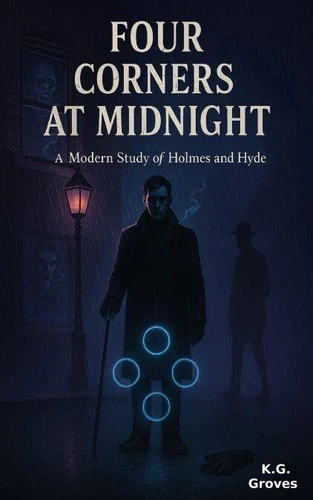
What if a city could learn?In Four Corners at Midnight, a contemporary reimagining of Sherlock Holmes and Dr. Jekyll's world unfolds inside a living urban landscape where walls listen, windows remember, and time itself develops habits. Holmes and Watson are no longer simply solving crimes. They are navigating subtle forces that influence behavior, rhythm, memory, and perception. As Edward Hyde's presence resurfaces in an unexpected form, the conflict becomes less about physical danger and more about psychological gravity.
Words shape air. Spaces respond to intention. Human consciousness becomes the true battleground. Each encounter builds toward a quiet tension where logic must learn how to negotiate with something older and less visible than reason. Written in immersive, literary prose, the novel blends psychological suspense, metaphysical mystery, philosophical inquiry, and modern mythmaking. The narrative unfolds through sensory detail, atmospheric pacing, and layered symbolism rather than conventional action beats, inviting readers into a deeply textured experience of place, thought, and human vulnerability.
This story stands independently while respectfully drawing from the public-domain foundations of Arthur Conan Doyle and Robert Louis Stevenson. No prior familiarity with the originals is required. Ideal for readers who appreciate: Literary speculative fiction Psychological and philosophical narratives Slow-burn atmospheric storytelling Modern reinterpretations of classic characters Intelligent, immersive prose Four Corners at Midnight is a novel about how systems shape people, how silence carries weight, and how attention itself becomes a form of power.
What if a city could learn?In Four Corners at Midnight, a contemporary reimagining of Sherlock Holmes and Dr. Jekyll's world unfolds inside a living urban landscape where walls listen, windows remember, and time itself develops habits. Holmes and Watson are no longer simply solving crimes. They are navigating subtle forces that influence behavior, rhythm, memory, and perception. As Edward Hyde's presence resurfaces in an unexpected form, the conflict becomes less about physical danger and more about psychological gravity.
Words shape air. Spaces respond to intention. Human consciousness becomes the true battleground. Each encounter builds toward a quiet tension where logic must learn how to negotiate with something older and less visible than reason. Written in immersive, literary prose, the novel blends psychological suspense, metaphysical mystery, philosophical inquiry, and modern mythmaking. The narrative unfolds through sensory detail, atmospheric pacing, and layered symbolism rather than conventional action beats, inviting readers into a deeply textured experience of place, thought, and human vulnerability.
This story stands independently while respectfully drawing from the public-domain foundations of Arthur Conan Doyle and Robert Louis Stevenson. No prior familiarity with the originals is required. Ideal for readers who appreciate: Literary speculative fiction Psychological and philosophical narratives Slow-burn atmospheric storytelling Modern reinterpretations of classic characters Intelligent, immersive prose Four Corners at Midnight is a novel about how systems shape people, how silence carries weight, and how attention itself becomes a form of power.

 , qui est-ce ?