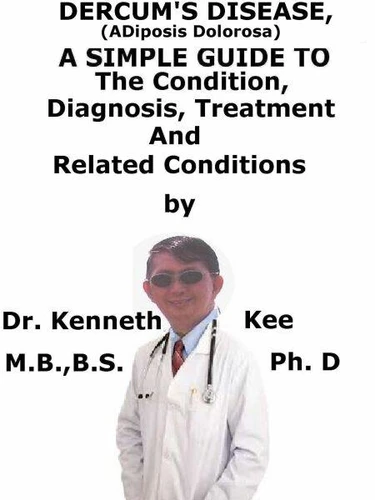
Dercum’s Disease, (Adiposis Dolorosa) A Simple Guide To The Condition, Diagnosis, Treatment And Related Conditions
Par :Formats :
Disponible dans votre compte client Decitre ou Furet du Nord dès validation de votre commande. Le format ePub est :
- Compatible avec une lecture sur My Vivlio (smartphone, tablette, ordinateur)
- Compatible avec une lecture sur liseuses Vivlio
- Pour les liseuses autres que Vivlio, vous devez utiliser le logiciel Adobe Digital Edition. Non compatible avec la lecture sur les liseuses Kindle, Remarkable et Sony
 , qui est-ce ?
Notre partenaire de plateforme de lecture numérique où vous retrouverez l'ensemble de vos ebooks gratuitement
Pour en savoir plus sur nos ebooks, consultez notre aide en ligne ici
C'est si simple ! Lisez votre ebook avec l'app Vivlio sur votre tablette, mobile ou ordinateur :

- FormatePub
- ISBN978-1-005-77288-8
- EAN9781005772888
- Date de parution25/09/2020
- Protection num.pas de protection
- Infos supplémentairesepub
- ÉditeurC. C. Chamberlane
Résumé
This book describes Dercum's Disease (Adiposis Dolorosa), Diagnosis and Treatment and Related DiseasesDercum's disease is a rare disorder that produces painful growths of fatty tissue called lipomas in subcutaneous fat tissue. It is also known as Adiposis dolorosa, Ander syndrome, adipose tissue rheumatism, adiposalgia, or lipomatosis dolorosa. This disorder normally involves the torso, upper arms, or upper legs.
Different areas of the body may swell for no apparent cause. The swelling may vanish without treatment, leaving hardened tissue or pendulous skin tags. Some doctors have lobbied for a "minimal definition" of Dercum's disease (adiposis dolorosa), which was recently proposed to include these:1. Generalized obesity2. Chronic pain (>3 mo) in the adipose tissueCriteria for diagnosisThere are 4 cardinal symptoms of Dercum's disease (adiposis dolorosa), and these remain the standard for diagnosis of classic disease:1.
Multiple, painful, fatty masses2. Generalized obesity, normally in menopausal age3. Asthenia4. Neuropsychiatric disorders, such as emotional instability, depression, epilepsy, confusion, and dementiaDercum's disease is anywhere from 5 to 30 times more frequent in women. CauseThe underlying cause of Dercum's disease remains unknown. Possible causes have been indicated, but none have been confirmed.
These have involved long-term treatment with:1. High-dose corticosteroids;2. Endocrine system abnormalities;3. Nervous system dysfunction;4. Mechanical pressure on nerves, adipose tissue dysfunction;5. Trauma; and6. Changes in fatty acid or carbohydrate metabolism. Researchers have also indicated that it could be an autoimmune disorder which is a disease that produces the immune system to mistakenly attack healthy tissue.
Others believe it is a metabolic disorder related to not being able to properly break down fat. Since the disorder has rarely happened in more than one person within a family, it may have a genetic component. No specific gene known to be linked with the disorder has been identified. The origin of the pain linked with the disorder is also poorly understood. It is believed that fatty deposits produce nerve compression, resulting in weakness and pain.
Most cases of Dercum's disease are sporadic (not inherited). This means that it normally happens in people with no family history of the disorder. In some of these cases, it seems to have been inherited in an autosomal dominant route. In these instances, when an affected person has children, each child has a 50% (1 in 2) risk to inherit the gene causing the disorder. Dercum's disease is classified into four stages:I.
Generalized diffuse form - a type of disease with diffusely present painful lipomasII. Generalized nodular form - a type of disease with the evidence of general pain in and in the neighboring tissue of multiple lipomas. III. Localized nodular form - a type of disease with the present pain in and around the lipomasIV. Juxtaarticular form - a type of disease with solitary lipomas at the internal parts of the knee.
The most prominent symptoms are:1. Sleep disorder, 2. Anxiety, 3. Depression, 4. Cognitive impairment, 5. Tachycardia, 6. Respiratory disorders and7. Gastrointestinal malfunction. Dercum's disease is the same as fibromyalgia but with the presence of painful lipomas. The presence of pain is needed for an adequate diagnosis. The treatment normally focuses on pain treatment:Pain relieversCortisoneMethotrexateInterferon alphaOther treatments are:Surgical removal of lipomasLiposuctionIntravenous lidocaine...
Different areas of the body may swell for no apparent cause. The swelling may vanish without treatment, leaving hardened tissue or pendulous skin tags. Some doctors have lobbied for a "minimal definition" of Dercum's disease (adiposis dolorosa), which was recently proposed to include these:1. Generalized obesity2. Chronic pain (>3 mo) in the adipose tissueCriteria for diagnosisThere are 4 cardinal symptoms of Dercum's disease (adiposis dolorosa), and these remain the standard for diagnosis of classic disease:1.
Multiple, painful, fatty masses2. Generalized obesity, normally in menopausal age3. Asthenia4. Neuropsychiatric disorders, such as emotional instability, depression, epilepsy, confusion, and dementiaDercum's disease is anywhere from 5 to 30 times more frequent in women. CauseThe underlying cause of Dercum's disease remains unknown. Possible causes have been indicated, but none have been confirmed.
These have involved long-term treatment with:1. High-dose corticosteroids;2. Endocrine system abnormalities;3. Nervous system dysfunction;4. Mechanical pressure on nerves, adipose tissue dysfunction;5. Trauma; and6. Changes in fatty acid or carbohydrate metabolism. Researchers have also indicated that it could be an autoimmune disorder which is a disease that produces the immune system to mistakenly attack healthy tissue.
Others believe it is a metabolic disorder related to not being able to properly break down fat. Since the disorder has rarely happened in more than one person within a family, it may have a genetic component. No specific gene known to be linked with the disorder has been identified. The origin of the pain linked with the disorder is also poorly understood. It is believed that fatty deposits produce nerve compression, resulting in weakness and pain.
Most cases of Dercum's disease are sporadic (not inherited). This means that it normally happens in people with no family history of the disorder. In some of these cases, it seems to have been inherited in an autosomal dominant route. In these instances, when an affected person has children, each child has a 50% (1 in 2) risk to inherit the gene causing the disorder. Dercum's disease is classified into four stages:I.
Generalized diffuse form - a type of disease with diffusely present painful lipomasII. Generalized nodular form - a type of disease with the evidence of general pain in and in the neighboring tissue of multiple lipomas. III. Localized nodular form - a type of disease with the present pain in and around the lipomasIV. Juxtaarticular form - a type of disease with solitary lipomas at the internal parts of the knee.
The most prominent symptoms are:1. Sleep disorder, 2. Anxiety, 3. Depression, 4. Cognitive impairment, 5. Tachycardia, 6. Respiratory disorders and7. Gastrointestinal malfunction. Dercum's disease is the same as fibromyalgia but with the presence of painful lipomas. The presence of pain is needed for an adequate diagnosis. The treatment normally focuses on pain treatment:Pain relieversCortisoneMethotrexateInterferon alphaOther treatments are:Surgical removal of lipomasLiposuctionIntravenous lidocaine...
A propos de Kenneth Kee


4,49 €