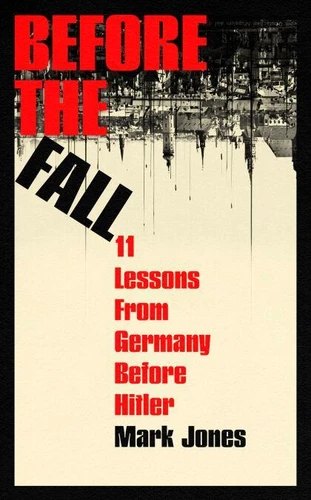
Before the Fall. Eleven Lessons from Germany Before Hitler
Par :Formats :
Actuellement indisponible
Cet article est actuellement indisponible, il ne peut pas être commandé sur notre site pour le moment. Nous vous invitons à vous inscrire à l'alerte disponibilité, vous recevrez un e-mail dès que cet ouvrage sera à nouveau disponible.
Disponible dans votre compte client Decitre ou Furet du Nord dès validation de votre commande. Le format ePub protégé est :
- Compatible avec une lecture sur My Vivlio (smartphone, tablette, ordinateur)
- Compatible avec une lecture sur liseuses Vivlio
- Pour les liseuses autres que Vivlio, vous devez utiliser le logiciel Adobe Digital Edition. Non compatible avec la lecture sur les liseuses Kindle, Remarkable et Sony
- Non compatible avec un achat hors France métropolitaine
 , qui est-ce ?
Notre partenaire de plateforme de lecture numérique où vous retrouverez l'ensemble de vos ebooks gratuitement
Pour en savoir plus sur nos ebooks, consultez notre aide en ligne ici
C'est si simple ! Lisez votre ebook avec l'app Vivlio sur votre tablette, mobile ou ordinateur :

- Nombre de pages320
- Date de parution24/09/2026
- FormatePub
- ISBN978-1-3998-3158-1
- EAN9781399831581
- Protection num.Adobe DRM
- Infos supplémentairesepub
- ÉditeurBasic Books
Résumé
Lessons we can learn from Weimar: the last time democracy chose to end itself. The constitution of the Weimar Republic was a watershed moment in politics, an attempt to create a modern political system that secured compromise between rich and poor, and a society that offered equal rights to men and women. The start of the Republic was the first time that German women could vote and become parliamentarians, as well as the first time that a state anywhere in the world provided funding for an organization that would campaign for gay and transsexual rights.
Despite overcoming its turbulent beginnings, including violent attempts to overthrow the new order led by extremists of the political left and right, the Weimar Republic's best years began in 1924 but did not last. By 1930 the Republic's end was already in sight. We are all liberal subjects in crisis. Just like people living in Germany one hundred years ago, we live in a time of accelerated technological change.
We find it hard to cope with new and growing challenges, and we wonder about what has happened to our cultures, identities and our ability to control events taking place on a global scale. We, like them, face up to a world of industrialized economies where managers constantly seek to optimize the speed of production and reduce costs to maximize profits. Like Weimar, our governments are democratically chosen by men and women, who have the equal right to vote.
But just as was the case in Weimar, we also live in democracies where billionaire businessmen enter politics not just to shape policy but also to fundamentally bend the essence of the state and the political system to their advantage. As bad as these similarities may be, this book is not suggesting that the western world is reliving the end of the Weimar Republic step by step. Things being comparable, in other words, does not mean that they are entirely the same.
But that doesn't mean that there aren't lessons to be learned about the origins of our present conditions from the political and cultural history of Weimar Germany. The arguments that follow are based upon some twenty years of research and thinking about Weimar. They include analysis of events and interpretations that are shared here for the first time. Like us, Weimar's democrats were trying to save their system and shore up the shaking foundations that were the result of the first crisis of classical modernity.
Instead of thinking that we have arrived in totalitarianism, by measuring our present moment against the history of Weimar democracy, we can see more clearly what is genuinely unique about our current moment, and what strategies are needed to bring an end to our own moment of liberal despair.
Despite overcoming its turbulent beginnings, including violent attempts to overthrow the new order led by extremists of the political left and right, the Weimar Republic's best years began in 1924 but did not last. By 1930 the Republic's end was already in sight. We are all liberal subjects in crisis. Just like people living in Germany one hundred years ago, we live in a time of accelerated technological change.
We find it hard to cope with new and growing challenges, and we wonder about what has happened to our cultures, identities and our ability to control events taking place on a global scale. We, like them, face up to a world of industrialized economies where managers constantly seek to optimize the speed of production and reduce costs to maximize profits. Like Weimar, our governments are democratically chosen by men and women, who have the equal right to vote.
But just as was the case in Weimar, we also live in democracies where billionaire businessmen enter politics not just to shape policy but also to fundamentally bend the essence of the state and the political system to their advantage. As bad as these similarities may be, this book is not suggesting that the western world is reliving the end of the Weimar Republic step by step. Things being comparable, in other words, does not mean that they are entirely the same.
But that doesn't mean that there aren't lessons to be learned about the origins of our present conditions from the political and cultural history of Weimar Germany. The arguments that follow are based upon some twenty years of research and thinking about Weimar. They include analysis of events and interpretations that are shared here for the first time. Like us, Weimar's democrats were trying to save their system and shore up the shaking foundations that were the result of the first crisis of classical modernity.
Instead of thinking that we have arrived in totalitarianism, by measuring our present moment against the history of Weimar democracy, we can see more clearly what is genuinely unique about our current moment, and what strategies are needed to bring an end to our own moment of liberal despair.