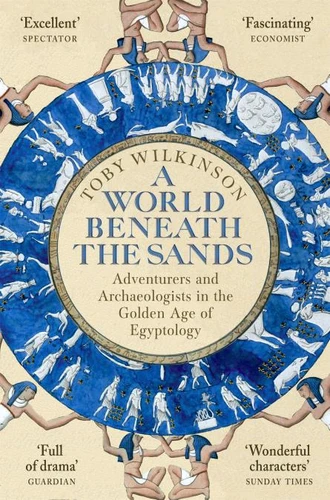
A World Beneath the Sands. Adventurers and Archaeologists in the Golden Age of Egyptology
Par :Formats :
Disponible dans votre compte client Decitre ou Furet du Nord dès validation de votre commande. Le format ePub protégé est :
- Compatible avec une lecture sur My Vivlio (smartphone, tablette, ordinateur)
- Compatible avec une lecture sur liseuses Vivlio
- Pour les liseuses autres que Vivlio, vous devez utiliser le logiciel Adobe Digital Edition. Non compatible avec la lecture sur les liseuses Kindle, Remarkable et Sony
- Non compatible avec un achat hors France métropolitaine
 , qui est-ce ?
Notre partenaire de plateforme de lecture numérique où vous retrouverez l'ensemble de vos ebooks gratuitement
Pour en savoir plus sur nos ebooks, consultez notre aide en ligne ici
C'est si simple ! Lisez votre ebook avec l'app Vivlio sur votre tablette, mobile ou ordinateur :

- Nombre de pages512
- FormatePub
- ISBN978-1-5098-5871-2
- EAN9781509858712
- Date de parution15/10/2020
- Protection num.Adobe DRM
- Infos supplémentairesepub
- ÉditeurPicador
Résumé
'It is a story full of drama, with the Nile, the pyramids and the Valley of the Kings as backdrop. That A World Beneath the Sands is also a subtle and stimulating study of the paradoxes of 19th-century colonialism is a bonus indeed.' - Tom Holland, GuardianWhat could be more exciting, more exotic or more intrepid than digging in the sands of Egypt in the hope of discovering golden treasures from the age of the pharaohs? Our fascination with ancient Egypt goes back to the ancient Greeks.
But the heyday of Egyptology was undoubtedly the nineteenth and early twentieth centuries. This golden age of scholarship and adventure is neatly book-ended by two epoch-making events: Champollion's decipherment of hieroglyphics in 1822 and the discovery of Tutankhamun's tomb by Howard Carter and Lord Carnarvon a hundred years later. In A World Beneath the Sands, the acclaimed Egyptologist Toby Wilkinson tells the riveting stories of the men and women whose obsession with Egypt's ancient civilisation drove them to uncover its secrets.
Champollion, Carter and Carnarvon are here, but so too are their lesser-known contemporaries, such as the Prussian scholar Karl Richard Lepsius, the Frenchman Auguste Mariette and the British aristocrat Lucie Duff-Gordon. Their work - and those of others like them - helped to enrich and transform our understanding of the Nile Valley and its people, and left a lasting impression on Egypt, too. Travellers and treasure-hunters, ethnographers and epigraphers, antiquarians and archaeologists: whatever their motives, whatever their methods, all understood that in pursuing Egyptology they were part of a greater endeavour - to reveal a lost world, buried for centuries beneath the sands.
But the heyday of Egyptology was undoubtedly the nineteenth and early twentieth centuries. This golden age of scholarship and adventure is neatly book-ended by two epoch-making events: Champollion's decipherment of hieroglyphics in 1822 and the discovery of Tutankhamun's tomb by Howard Carter and Lord Carnarvon a hundred years later. In A World Beneath the Sands, the acclaimed Egyptologist Toby Wilkinson tells the riveting stories of the men and women whose obsession with Egypt's ancient civilisation drove them to uncover its secrets.
Champollion, Carter and Carnarvon are here, but so too are their lesser-known contemporaries, such as the Prussian scholar Karl Richard Lepsius, the Frenchman Auguste Mariette and the British aristocrat Lucie Duff-Gordon. Their work - and those of others like them - helped to enrich and transform our understanding of the Nile Valley and its people, and left a lasting impression on Egypt, too. Travellers and treasure-hunters, ethnographers and epigraphers, antiquarians and archaeologists: whatever their motives, whatever their methods, all understood that in pursuing Egyptology they were part of a greater endeavour - to reveal a lost world, buried for centuries beneath the sands.
'It is a story full of drama, with the Nile, the pyramids and the Valley of the Kings as backdrop. That A World Beneath the Sands is also a subtle and stimulating study of the paradoxes of 19th-century colonialism is a bonus indeed.' - Tom Holland, GuardianWhat could be more exciting, more exotic or more intrepid than digging in the sands of Egypt in the hope of discovering golden treasures from the age of the pharaohs? Our fascination with ancient Egypt goes back to the ancient Greeks.
But the heyday of Egyptology was undoubtedly the nineteenth and early twentieth centuries. This golden age of scholarship and adventure is neatly book-ended by two epoch-making events: Champollion's decipherment of hieroglyphics in 1822 and the discovery of Tutankhamun's tomb by Howard Carter and Lord Carnarvon a hundred years later. In A World Beneath the Sands, the acclaimed Egyptologist Toby Wilkinson tells the riveting stories of the men and women whose obsession with Egypt's ancient civilisation drove them to uncover its secrets.
Champollion, Carter and Carnarvon are here, but so too are their lesser-known contemporaries, such as the Prussian scholar Karl Richard Lepsius, the Frenchman Auguste Mariette and the British aristocrat Lucie Duff-Gordon. Their work - and those of others like them - helped to enrich and transform our understanding of the Nile Valley and its people, and left a lasting impression on Egypt, too. Travellers and treasure-hunters, ethnographers and epigraphers, antiquarians and archaeologists: whatever their motives, whatever their methods, all understood that in pursuing Egyptology they were part of a greater endeavour - to reveal a lost world, buried for centuries beneath the sands.
But the heyday of Egyptology was undoubtedly the nineteenth and early twentieth centuries. This golden age of scholarship and adventure is neatly book-ended by two epoch-making events: Champollion's decipherment of hieroglyphics in 1822 and the discovery of Tutankhamun's tomb by Howard Carter and Lord Carnarvon a hundred years later. In A World Beneath the Sands, the acclaimed Egyptologist Toby Wilkinson tells the riveting stories of the men and women whose obsession with Egypt's ancient civilisation drove them to uncover its secrets.
Champollion, Carter and Carnarvon are here, but so too are their lesser-known contemporaries, such as the Prussian scholar Karl Richard Lepsius, the Frenchman Auguste Mariette and the British aristocrat Lucie Duff-Gordon. Their work - and those of others like them - helped to enrich and transform our understanding of the Nile Valley and its people, and left a lasting impression on Egypt, too. Travellers and treasure-hunters, ethnographers and epigraphers, antiquarians and archaeologists: whatever their motives, whatever their methods, all understood that in pursuing Egyptology they were part of a greater endeavour - to reveal a lost world, buried for centuries beneath the sands.