
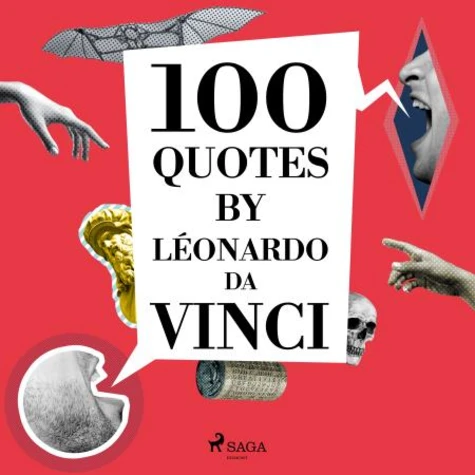
100 Quotes by Léonardo da Vinci
Par : ,Formats :
Disponible dans votre compte client Decitre ou Furet du Nord dès validation de votre commande. Le format MP3 est :
- Pour les liseuses autres que Vivlio, vous devez utiliser le logiciel Adobe Digital Edition. Non compatible avec la lecture sur les liseuses Kindle, Remarkable et Sony
 , qui est-ce ?
Notre partenaire de plateforme de lecture numérique où vous retrouverez l'ensemble de vos ebooks gratuitement
Pour en savoir plus sur nos ebooks, consultez notre aide en ligne ici
C'est si simple ! Lisez votre ebook avec l'app Vivlio sur votre tablette, mobile ou ordinateur :

- FormatMP3
- ISBN978-2-8211-1637-5
- EAN9782821116375
- Date de parution01/04/2022
- Protection num.pas de protection
- Taille13 Mo
- Infos supplémentairesaudio
- ÉditeurSAGA Egmont
Résumé
'100 Quotes by Leonardo da Vinci' is a collection of quotes from one of the greatest minds that ever lived. Transposed from his extensive collection of notebooks, you'll find thoughts and reflections on a variety of subjects, including art, philosophy, and economics. Often pithy and always intelligent, this is a superb book for those who want to get to know this celebrated artist that much better.
While most famous as the artist behind the Mona Lisa's enigmatic smile, Leonardo da Vinci (1452 - 1519) was also a scientist, draughtsman, engineer, architect, and sculptor.
Thought to have been born in the Italian town of Vinci, he was raised by his mother and grandfather. After his family moved to Florence, he trained in artistic disciplines under the eye of Andrea del Verrocchio. By the age of 20, da Vinci had been offered a place in the Guild of St Luke, where he achieved his first professional commission. Many more followed, including work for the Confraternity of the Immaculate Conception and mapwork for Cesare Borgia. Among his literary works, da Vinci wrote more than 50 notebooks, encompassing an estimated 28, 000 pages.
These include notes and essays on philosophy and warfare.
Thought to have been born in the Italian town of Vinci, he was raised by his mother and grandfather. After his family moved to Florence, he trained in artistic disciplines under the eye of Andrea del Verrocchio. By the age of 20, da Vinci had been offered a place in the Guild of St Luke, where he achieved his first professional commission. Many more followed, including work for the Confraternity of the Immaculate Conception and mapwork for Cesare Borgia. Among his literary works, da Vinci wrote more than 50 notebooks, encompassing an estimated 28, 000 pages.
These include notes and essays on philosophy and warfare.
A propos de Leonardo da Vinci
7,99 €
500 Quotes to Stimulate Creativity
Audiobook
7,99 €
500 Quotes: an Original Selection
Audiobook
7,99 €