- Accueil /
- Brigitte Feuillet
Brigitte Feuillet

Dernière sortie
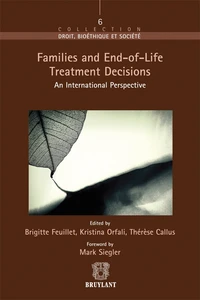
Families and End-of-Life Treatment Decisions
"The book of life is the supreme book that we can neither close nor reopen at will."This quotation from Lamartine, the French poet, once a perfect illustration of the end of life in bygone societies, can no longer be said to apply. In fact, today, in one out of two cases in our modern societies, it is the medical team who closes this book without any intention of cutting life short. Generally, however, the physicians do not make this decision alone.
While a competent patient increasingly participates in medical decisions, including when it's a matter of life or death, those nearest to him (usually the family but not always) endorse this responsibility once he becomes incapable of expressing his wishes. Many questions surround not only this concept of « nearest and dearest », or "loved ones", but also their roles and legitimacy. Whether they act as the patient's legal representative, authorised agent or trustee, or if they are stripped of all legal power, will the « loved one » be simply consulted by the caregivers on the presumed wishes of the patient regarding end-of-life choices? Or must they guarantee him a genuine right of self-determination? To this end, will they be granted a right of information only about the patient's condition, or even access to his medical records? Will their role be affected by the existence of living wills drawn up by the patient in question ?The outcome of debates between legal experts and physicians, philosophers and sociologists from seventeen countries, the chapters in this book analyse the current status and role of these relatives (and non- relatives) close to the patient at the end of life.
Numerous European national laws are thus compared and are also benchmarked against other practices, in North and South America, in Africa and in some Asian countries. Beyond the legal, cultural and ethical differences that clearly separate these various traditions, a recurrent question arises: more than providing paternalistic protection, does the "loved one" not always have to ensure respect for what « their patient » would have wanted, thus guaranteeing up to the end of his life a basic right, namely his decision-making autonomy? If this book demonstrates the difficulty of such a task in different contexts, it also attempts to pave the way to a more humanistic approach across cultures to advocate respect for the patient at the very end of his life.
While a competent patient increasingly participates in medical decisions, including when it's a matter of life or death, those nearest to him (usually the family but not always) endorse this responsibility once he becomes incapable of expressing his wishes. Many questions surround not only this concept of « nearest and dearest », or "loved ones", but also their roles and legitimacy. Whether they act as the patient's legal representative, authorised agent or trustee, or if they are stripped of all legal power, will the « loved one » be simply consulted by the caregivers on the presumed wishes of the patient regarding end-of-life choices? Or must they guarantee him a genuine right of self-determination? To this end, will they be granted a right of information only about the patient's condition, or even access to his medical records? Will their role be affected by the existence of living wills drawn up by the patient in question ?The outcome of debates between legal experts and physicians, philosophers and sociologists from seventeen countries, the chapters in this book analyse the current status and role of these relatives (and non- relatives) close to the patient at the end of life.
Numerous European national laws are thus compared and are also benchmarked against other practices, in North and South America, in Africa and in some Asian countries. Beyond the legal, cultural and ethical differences that clearly separate these various traditions, a recurrent question arises: more than providing paternalistic protection, does the "loved one" not always have to ensure respect for what « their patient » would have wanted, thus guaranteeing up to the end of his life a basic right, namely his decision-making autonomy? If this book demonstrates the difficulty of such a task in different contexts, it also attempts to pave the way to a more humanistic approach across cultures to advocate respect for the patient at the very end of his life.
"The book of life is the supreme book that we can neither close nor reopen at will."This quotation from Lamartine, the French poet, once a perfect illustration of the end of life in bygone societies, can no longer be said to apply. In fact, today, in one out of two cases in our modern societies, it is the medical team who closes this book without any intention of cutting life short. Generally, however, the physicians do not make this decision alone.
While a competent patient increasingly participates in medical decisions, including when it's a matter of life or death, those nearest to him (usually the family but not always) endorse this responsibility once he becomes incapable of expressing his wishes. Many questions surround not only this concept of « nearest and dearest », or "loved ones", but also their roles and legitimacy. Whether they act as the patient's legal representative, authorised agent or trustee, or if they are stripped of all legal power, will the « loved one » be simply consulted by the caregivers on the presumed wishes of the patient regarding end-of-life choices? Or must they guarantee him a genuine right of self-determination? To this end, will they be granted a right of information only about the patient's condition, or even access to his medical records? Will their role be affected by the existence of living wills drawn up by the patient in question ?The outcome of debates between legal experts and physicians, philosophers and sociologists from seventeen countries, the chapters in this book analyse the current status and role of these relatives (and non- relatives) close to the patient at the end of life.
Numerous European national laws are thus compared and are also benchmarked against other practices, in North and South America, in Africa and in some Asian countries. Beyond the legal, cultural and ethical differences that clearly separate these various traditions, a recurrent question arises: more than providing paternalistic protection, does the "loved one" not always have to ensure respect for what « their patient » would have wanted, thus guaranteeing up to the end of his life a basic right, namely his decision-making autonomy? If this book demonstrates the difficulty of such a task in different contexts, it also attempts to pave the way to a more humanistic approach across cultures to advocate respect for the patient at the very end of his life.
While a competent patient increasingly participates in medical decisions, including when it's a matter of life or death, those nearest to him (usually the family but not always) endorse this responsibility once he becomes incapable of expressing his wishes. Many questions surround not only this concept of « nearest and dearest », or "loved ones", but also their roles and legitimacy. Whether they act as the patient's legal representative, authorised agent or trustee, or if they are stripped of all legal power, will the « loved one » be simply consulted by the caregivers on the presumed wishes of the patient regarding end-of-life choices? Or must they guarantee him a genuine right of self-determination? To this end, will they be granted a right of information only about the patient's condition, or even access to his medical records? Will their role be affected by the existence of living wills drawn up by the patient in question ?The outcome of debates between legal experts and physicians, philosophers and sociologists from seventeen countries, the chapters in this book analyse the current status and role of these relatives (and non- relatives) close to the patient at the end of life.
Numerous European national laws are thus compared and are also benchmarked against other practices, in North and South America, in Africa and in some Asian countries. Beyond the legal, cultural and ethical differences that clearly separate these various traditions, a recurrent question arises: more than providing paternalistic protection, does the "loved one" not always have to ensure respect for what « their patient » would have wanted, thus guaranteeing up to the end of his life a basic right, namely his decision-making autonomy? If this book demonstrates the difficulty of such a task in different contexts, it also attempts to pave the way to a more humanistic approach across cultures to advocate respect for the patient at the very end of his life.
Les livres de Brigitte Feuillet


Santé, argent et éthique : une indispensable conciliation ?. Etude française et tunisienne
Amel Aouij-Mrad, Marie-Hélène Douchez, Brigitte Feuillet, Collectif
E-book
18,99 €

Santé, argent et éthique : une indispensable conciliation ?. Etude française et tunisienne
Brigitte Feuillet, Marie-Hélène Douchez, Amel Aouij-Mrad
25,50 €

La place du juriste face à la norme. Tome 16, Journées nationales, Rennes
Philippe Bas, Thierry Bonneau, François Chénedé, Brigitte Feuillet
Grand Format
55,00 €

Families and End-of-Life Treatment Decisions. An International Perspective
Brigitte Feuillet, Kristina Orfali, Thérèse Callus
72,00 €

Droit, éthique et religion, quelles normes pour l'assistance médicale à la procréation ?. Etude franco-tunisienne
Amel Aouij-Mrad, Brigitte Feuillet, Philippe Portier
20,00 €