- Accueil /
- Bernard Schiele
Bernard Schiele

Dernière sortie
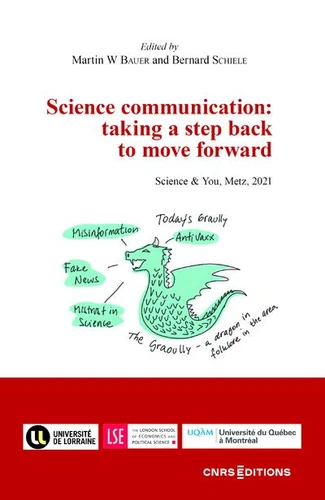
Science communication: taking a step back to move forward
For Science&You 2021, 16–19 November, the motto "taking a step back to move forward" was chosen. Why did we come up with this idea ? We took this phrase to be an invitation for a moment of reflection when the field of science communication is booming, to hold our momentum and to observe and think about what is going on in the field. This book is structured to examine and elaborate on challenges in science communication, and to that end is subdivided into three sections, each of which is subdivided into two subthemes.
The first section, titled Taking a Step Back, begins with the subtheme Taking Stock (chapters 1 to 6), bringing together the international keynote speakers who address the larger issues related to science communication : Michel Dubois (CNRS, Sorbonne University, France), Gordon Gauchat (University of Wisconsin–Milwaukee, United States), Julien Giry (Université de Tours, France), Mehita Kind (Stellenbosch University, South Africa), Kyoko Sato (Stanford University, United States), Peter Weingart (University of Bielefeld, Germany).
The second subtheme, Public Attitudes to Science Past and Present (chapters 7 to 10), examines the emerging "longue durée" perspective on the public's relationship with science. The second section deals with Current Topics and tackles two issues : Artificial Intelligence in Society is composed of six chapters exploring facets of that debate (chapters 11 to 16). The second subtheme (chapters 17 to 22), Antibiotics, Pandemics and Vaccines, highlights antibiotic resistance as a pressing public issue that stayed very much in the shadow of the Covid-19 pandemic.
The third section, Old and Ums Issues, brings together a selection of papers that focus on particular "devils" (called Graoullys in Metz) of science communication. The first subtheme (chapters 23 to 29), which takes on debates crisscrossing the social sphere, is aptly titled Collapsology, Pseudoscience, Disinformation, Fake News and Scientism. The last subtheme (chapters 30 to 36), New Opportunities, explores new avenues of reflection, such as the opportunities opened by the pandemic and the rapid institutionalisation of science communication.
The conclusion suggests going beyond the science/anti-science opposition and mapping discursive regimes.

The first section, titled Taking a Step Back, begins with the subtheme Taking Stock (chapters 1 to 6), bringing together the international keynote speakers who address the larger issues related to science communication : Michel Dubois (CNRS, Sorbonne University, France), Gordon Gauchat (University of Wisconsin–Milwaukee, United States), Julien Giry (Université de Tours, France), Mehita Kind (Stellenbosch University, South Africa), Kyoko Sato (Stanford University, United States), Peter Weingart (University of Bielefeld, Germany).
The second subtheme, Public Attitudes to Science Past and Present (chapters 7 to 10), examines the emerging "longue durée" perspective on the public's relationship with science. The second section deals with Current Topics and tackles two issues : Artificial Intelligence in Society is composed of six chapters exploring facets of that debate (chapters 11 to 16). The second subtheme (chapters 17 to 22), Antibiotics, Pandemics and Vaccines, highlights antibiotic resistance as a pressing public issue that stayed very much in the shadow of the Covid-19 pandemic.
The third section, Old and Ums Issues, brings together a selection of papers that focus on particular "devils" (called Graoullys in Metz) of science communication. The first subtheme (chapters 23 to 29), which takes on debates crisscrossing the social sphere, is aptly titled Collapsology, Pseudoscience, Disinformation, Fake News and Scientism. The last subtheme (chapters 30 to 36), New Opportunities, explores new avenues of reflection, such as the opportunities opened by the pandemic and the rapid institutionalisation of science communication.
The conclusion suggests going beyond the science/anti-science opposition and mapping discursive regimes.

For Science&You 2021, 16–19 November, the motto "taking a step back to move forward" was chosen. Why did we come up with this idea ? We took this phrase to be an invitation for a moment of reflection when the field of science communication is booming, to hold our momentum and to observe and think about what is going on in the field. This book is structured to examine and elaborate on challenges in science communication, and to that end is subdivided into three sections, each of which is subdivided into two subthemes.
The first section, titled Taking a Step Back, begins with the subtheme Taking Stock (chapters 1 to 6), bringing together the international keynote speakers who address the larger issues related to science communication : Michel Dubois (CNRS, Sorbonne University, France), Gordon Gauchat (University of Wisconsin–Milwaukee, United States), Julien Giry (Université de Tours, France), Mehita Kind (Stellenbosch University, South Africa), Kyoko Sato (Stanford University, United States), Peter Weingart (University of Bielefeld, Germany).
The second subtheme, Public Attitudes to Science Past and Present (chapters 7 to 10), examines the emerging "longue durée" perspective on the public's relationship with science. The second section deals with Current Topics and tackles two issues : Artificial Intelligence in Society is composed of six chapters exploring facets of that debate (chapters 11 to 16). The second subtheme (chapters 17 to 22), Antibiotics, Pandemics and Vaccines, highlights antibiotic resistance as a pressing public issue that stayed very much in the shadow of the Covid-19 pandemic.
The third section, Old and Ums Issues, brings together a selection of papers that focus on particular "devils" (called Graoullys in Metz) of science communication. The first subtheme (chapters 23 to 29), which takes on debates crisscrossing the social sphere, is aptly titled Collapsology, Pseudoscience, Disinformation, Fake News and Scientism. The last subtheme (chapters 30 to 36), New Opportunities, explores new avenues of reflection, such as the opportunities opened by the pandemic and the rapid institutionalisation of science communication.
The conclusion suggests going beyond the science/anti-science opposition and mapping discursive regimes.
The first section, titled Taking a Step Back, begins with the subtheme Taking Stock (chapters 1 to 6), bringing together the international keynote speakers who address the larger issues related to science communication : Michel Dubois (CNRS, Sorbonne University, France), Gordon Gauchat (University of Wisconsin–Milwaukee, United States), Julien Giry (Université de Tours, France), Mehita Kind (Stellenbosch University, South Africa), Kyoko Sato (Stanford University, United States), Peter Weingart (University of Bielefeld, Germany).
The second subtheme, Public Attitudes to Science Past and Present (chapters 7 to 10), examines the emerging "longue durée" perspective on the public's relationship with science. The second section deals with Current Topics and tackles two issues : Artificial Intelligence in Society is composed of six chapters exploring facets of that debate (chapters 11 to 16). The second subtheme (chapters 17 to 22), Antibiotics, Pandemics and Vaccines, highlights antibiotic resistance as a pressing public issue that stayed very much in the shadow of the Covid-19 pandemic.
The third section, Old and Ums Issues, brings together a selection of papers that focus on particular "devils" (called Graoullys in Metz) of science communication. The first subtheme (chapters 23 to 29), which takes on debates crisscrossing the social sphere, is aptly titled Collapsology, Pseudoscience, Disinformation, Fake News and Scientism. The last subtheme (chapters 30 to 36), New Opportunities, explores new avenues of reflection, such as the opportunities opened by the pandemic and the rapid institutionalisation of science communication.
The conclusion suggests going beyond the science/anti-science opposition and mapping discursive regimes.
Les livres de Bernard Schiele

24,99 €

17,99 €

Science communication: taking a step back to move forward. Science & You, Metz, 2021
Martin W. Bauer, Bernard Schiele
Grand Format
28,00 €

Regards interdisciplinaires sur les publics de la culture
Marie-Claude Larouche, Jason Luckerhoff, Stéphane Labbé
Grand Format
30,00 €

39,00 €

La publicisation de la science. Exposer, communiquer, débattre, publier, vulgariser
Isabelle Pailliart, Bernard Schiele, Daniel Jacobi, Joëlle Le Marec
21,40 €

25,00 €

24,00 €

22,00 €

Science communication today 2015. Current strategies and means of action
Bernard Schiele, Joëlle Le Marec, Patrick Baranger
12,00 €

20,00 €

La Revolution De La Museologie Des Sciences. Vers Les Musees Du 21eme Siecle
Emlyn Koster, Bernard Schiele
27,44 €