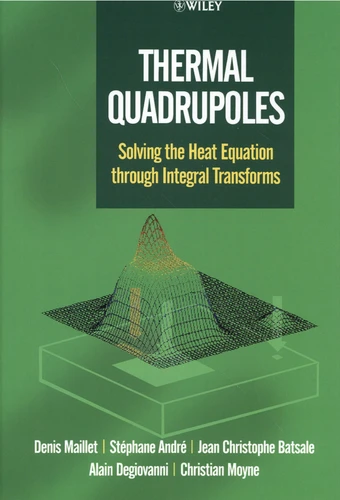
Thermal Quadrupoles describes a novel and powerful method which allows design engineers firstly to model a linear problem in heat conduction, then build a solution in an explicit form and finally obtain a numerical solution. It constitutes a modelling and calculation tool based on a very efficient and systemic methodological approach. The chapters in this book increase in complexity from a rapid presentation of the method for one dimensional transient problems in Chapter one, to non-uniform boundary conditions or inhomogeneous media in Chapter six.
In addition, a wide range of corrected problems of contemporary interest are presented mainly in Chapters three and six with their numerical implementation in MATLAB language. This book covers the whole scope of linear problems and presents a wide range of concrete issues of contemporary interest such as harmonic excitations of buildings, transfer in composée media, thermal contact resistance and moving material heat transfer.
Extensions of this method to coupled transfers in a semi-transparent medium and to mass transfer in porous media are considered respectively in Chapters seven and eight. Chapter nine is devoted to practical numerical methods that can be used to inverse the Laplace transform. Written from an engineering perspective, with applications to real engineering problems, this book will be of significant interest not only to ese mhe s, ecturers and graduate students in mechanical engineering (thermodynamics) and process engineers needing to model a heat transfer problem to obtain optimized operating conditions, but also to researchers interested in the simulation or design of experiments where heat transfer plays a significant role.
Thermal Quadrupoles describes a novel and powerful method which allows design engineers firstly to model a linear problem in heat conduction, then build a solution in an explicit form and finally obtain a numerical solution. It constitutes a modelling and calculation tool based on a very efficient and systemic methodological approach. The chapters in this book increase in complexity from a rapid presentation of the method for one dimensional transient problems in Chapter one, to non-uniform boundary conditions or inhomogeneous media in Chapter six.
In addition, a wide range of corrected problems of contemporary interest are presented mainly in Chapters three and six with their numerical implementation in MATLAB language. This book covers the whole scope of linear problems and presents a wide range of concrete issues of contemporary interest such as harmonic excitations of buildings, transfer in composée media, thermal contact resistance and moving material heat transfer.
Extensions of this method to coupled transfers in a semi-transparent medium and to mass transfer in porous media are considered respectively in Chapters seven and eight. Chapter nine is devoted to practical numerical methods that can be used to inverse the Laplace transform. Written from an engineering perspective, with applications to real engineering problems, this book will be of significant interest not only to ese mhe s, ecturers and graduate students in mechanical engineering (thermodynamics) and process engineers needing to model a heat transfer problem to obtain optimized operating conditions, but also to researchers interested in the simulation or design of experiments where heat transfer plays a significant role.