

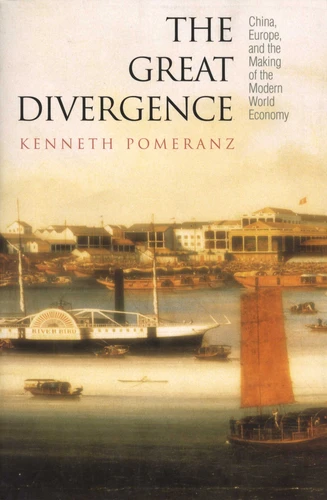
The Great Divergence. China, Europe, and the Making of the Modern World Economy
Par :Formats :
Actuellement indisponible
Cet article est actuellement indisponible, il ne peut pas être commandé sur notre site pour le moment. Nous vous invitons à vous inscrire à l'alerte disponibilité, vous recevrez un e-mail dès que cet ouvrage sera à nouveau disponible.
- Nombre de pages382
- FormatGrand Format
- PrésentationBroché
- Poids0.54 kg
- Dimensions15,6 cm × 23,5 cm × 2,3 cm
- ISBN0-691-09010-6
- EAN9780691090108
- Date de parution01/01/2000
- ÉditeurPrinceton University Press
Résumé
The Great Divergence brings new insight to one of the classic questions of history : Why did sustained industrial growth begin in Northwest Europe, despite surprising similarities between advanced areas of Europe and East Asia ? Kenneth Pomeranz shows, as recently as 1750, parallels between these two parts of the world in life expectancy, consumption, product and factor markets, the strategies of households, and perhaps most surprisingly, ecology.
Pomeranz argues that Europe's nineteenth-century divergence from the Old World owes much to the fortunate location of coal, which substituted for timber, and trade with the Americas. Together, coal and the New World allowed Europe to grow along resource-intensive, labor-saving paths. Meanwhile, Asia hit a cul-de-sac. Although the East Asian hinterlands boomed after 1750, both in population and in manufacturing, this growth prevented these peripheral regions from exporting vital resources to the cloth- Krproducing Yangzi Delta.
As a result, growth in the core of East Asia's economy essentially stopped, and what growth did exist was forced along labor-intensive, resource-saving paths—paths Europe could have been forced down, too, had i of been for favorable resource stock from underground and overseas.
Pomeranz argues that Europe's nineteenth-century divergence from the Old World owes much to the fortunate location of coal, which substituted for timber, and trade with the Americas. Together, coal and the New World allowed Europe to grow along resource-intensive, labor-saving paths. Meanwhile, Asia hit a cul-de-sac. Although the East Asian hinterlands boomed after 1750, both in population and in manufacturing, this growth prevented these peripheral regions from exporting vital resources to the cloth- Krproducing Yangzi Delta.
As a result, growth in the core of East Asia's economy essentially stopped, and what growth did exist was forced along labor-intensive, resource-saving paths—paths Europe could have been forced down, too, had i of been for favorable resource stock from underground and overseas.
Vous aimerez aussi
24,99 €

La dette sociale de la France. 1974-2024
Grand Format
28,90 €

La bible du concours SESAME
Edition 2026
Edition 2026
Grand Format
25,00 €