

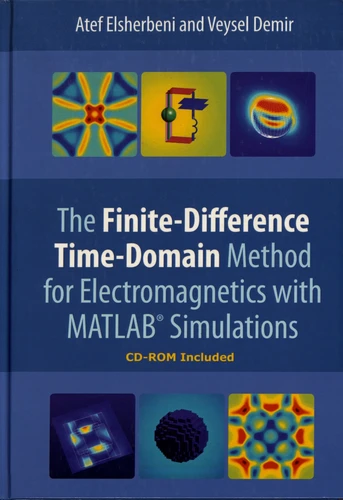
The Finite-Difference Time Domain Method for Electromagnetics with MATLAB Simulations
avec 1 Cédérom
Par : , Formats :
Actuellement indisponible
Cet article est actuellement indisponible, il ne peut pas être commandé sur notre site pour le moment. Nous vous invitons à vous inscrire à l'alerte disponibilité, vous recevrez un e-mail dès que cet ouvrage sera à nouveau disponible.
- Nombre de pages426
- FormatGrand Format
- PrésentationRelié
- Poids0.88 kg
- Dimensions18,0 cm × 26,0 cm × 2,0 cm
- ISBN978-1-891121-71-5
- EAN9781891121715
- Date de parution01/12/2009
- ÉditeurSciTech
Résumé
The scope of the book is the fundamental techniques in the FDTD method as applied to engineering electro-magnetics. The construction of final equations is presented with a detailed step-by-step approach. In most cases the full-set of equations are provided. The construction of equations is accompanied by a supporting set of 3-D illustrations and MATLAB codes. These figures greatly facilitate the understanding of the underlying concepts.
While the concepts are being presented, it has been kept in mind that the outcome of the book will be a software package that will be sufficient to solve several types of basic electromagnetic problems. In each chapter the transformation of the concepts into programming is explained. Therefore the chapters are presented in such a way that, by adding/developing a new part of the code, chapter by chapter, at the end a well developed FDTD simulation package will be constructed.
While the concepts are being presented, it has been kept in mind that the outcome of the book will be a software package that will be sufficient to solve several types of basic electromagnetic problems. In each chapter the transformation of the concepts into programming is explained. Therefore the chapters are presented in such a way that, by adding/developing a new part of the code, chapter by chapter, at the end a well developed FDTD simulation package will be constructed.
L'éditeur en parle
Key features : — The book presents the fundamental techniques of the FDTD method at a graduate level, taking readers from conceptual understanding to actual program development. — Full derivations are provided for final equations. — 3-D illustrations to aid in visualization of field components are provided. — Fully functional MATLAB code examples are provided.