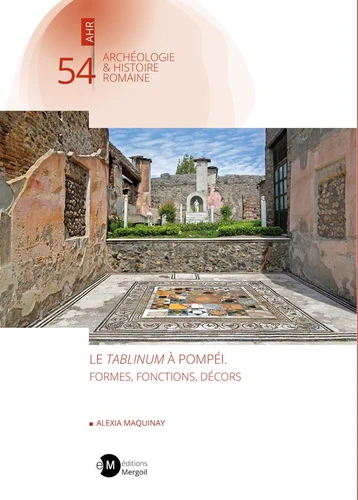
Dans les maisons de l'antiquité romaine, le tablinum attire irrémédiablement le regard. Implanté dans l'axe longitudinal de l'entrée, prolongeant l'atrium, cet espace a, en outre, la particularité d'être dépourvu de mur sur l'avant, d'où l'importance de son décor et de son mobilier. Qu'il n'ait encore jamais fait l'objet d'une rétrospective peut surprendre, eu égard à sa constance dans l'architecture privée des Romains.
Il existe toujours, en outre, plusieurs interprétations contradictoires sur sa définition, son apparition dans le schéma des domus italiques, son évolution architecturale et stylistique. A travers les témoignages du genre les mieux conservés du monde romain : ceux de la cité campanienne de Pompéi, la présente étude s'attache à retracer l'histoire cette pièce traditionnelle de la maison romaine, son origine étrusque, ses différentes formes et articulations, d'exposer toute la gamme de décors qui ornaient ses murs et de revenir sur les différentes fonctions qu'elle put occuper au cours des siècles, grâce aux sources latines et au mobilier archéologique de l'an 79 de notre ère, mis au jour lors des fouilles dans les cités vésuviennes.
In ancient Roman houses, the tablinum irresistibly draws the eye. Positioned along the longitudinal axis of the entrance, extending from the atrium, this space is particularly notable for its open-front design, lacking a wall on its anterior side, which emphasizes the importance of its decoration and furnishings. That it has never been the subject of a comprehensive retrospective may seem surprising, given its consistent presence in Roman private architecture.
Moreover, there remain several contradictory interpretations regarding its definition, its emergence within the layout of Italic domus, and its architectural and stylistic evolution. Drawing on the best-preserved examples of this type of space from the Roman world - those found in the Campanian city of Pompeii - this study aims to trace the history of this traditional room in the Roman house, its Etruscan origins, its various forms and configurations, to showcase the full range of decorative schemes adorning its walls, and to revisit its multiple functions over the centuries.
This analysis is supported by Latin sources and the archaeological furnishings from 79 CE unearthed during excavations in the Vesuvian cities.
Dans les maisons de l'antiquité romaine, le tablinum attire irrémédiablement le regard. Implanté dans l'axe longitudinal de l'entrée, prolongeant l'atrium, cet espace a, en outre, la particularité d'être dépourvu de mur sur l'avant, d'où l'importance de son décor et de son mobilier. Qu'il n'ait encore jamais fait l'objet d'une rétrospective peut surprendre, eu égard à sa constance dans l'architecture privée des Romains.
Il existe toujours, en outre, plusieurs interprétations contradictoires sur sa définition, son apparition dans le schéma des domus italiques, son évolution architecturale et stylistique. A travers les témoignages du genre les mieux conservés du monde romain : ceux de la cité campanienne de Pompéi, la présente étude s'attache à retracer l'histoire cette pièce traditionnelle de la maison romaine, son origine étrusque, ses différentes formes et articulations, d'exposer toute la gamme de décors qui ornaient ses murs et de revenir sur les différentes fonctions qu'elle put occuper au cours des siècles, grâce aux sources latines et au mobilier archéologique de l'an 79 de notre ère, mis au jour lors des fouilles dans les cités vésuviennes.
In ancient Roman houses, the tablinum irresistibly draws the eye. Positioned along the longitudinal axis of the entrance, extending from the atrium, this space is particularly notable for its open-front design, lacking a wall on its anterior side, which emphasizes the importance of its decoration and furnishings. That it has never been the subject of a comprehensive retrospective may seem surprising, given its consistent presence in Roman private architecture.
Moreover, there remain several contradictory interpretations regarding its definition, its emergence within the layout of Italic domus, and its architectural and stylistic evolution. Drawing on the best-preserved examples of this type of space from the Roman world - those found in the Campanian city of Pompeii - this study aims to trace the history of this traditional room in the Roman house, its Etruscan origins, its various forms and configurations, to showcase the full range of decorative schemes adorning its walls, and to revisit its multiple functions over the centuries.
This analysis is supported by Latin sources and the archaeological furnishings from 79 CE unearthed during excavations in the Vesuvian cities.