
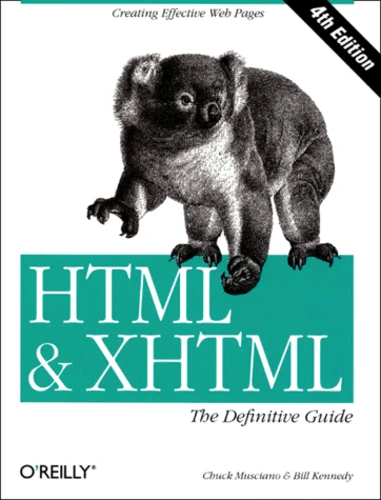
Html & Xhtml. The Definitive Guide, 4th Edition
Par : ,Formats :
Actuellement indisponible
Cet article est actuellement indisponible, il ne peut pas être commandé sur notre site pour le moment. Nous vous invitons à vous inscrire à l'alerte disponibilité, vous recevrez un e-mail dès que cet ouvrage sera à nouveau disponible.
- Nombre de pages660
- PrésentationBroché
- Poids1.005 kg
- Dimensions17,9 cm × 23,3 cm × 3,2 cm
- ISBN0-596-00026-X
- EAN9780596000264
- Date de parution27/09/2000
- ÉditeurO'Reilly
Résumé
Netscape Navigator 6.0! Internet Explorer 5.0! HTML 4.01! XML and XHTML! Style sheets! HTML is changing so fast that it's almost impossible to keep up with developments. How do you know what's real, and how do you use it? HML & XHML: The Definitive Guide brings it all together for you. It is the most comprehensive book available on HTML today. It covers the latest standards, HTML 4.01, XHTML 1.0, and all the features supported by the popular web browsers.
Learning HTML or XHTML is like learning a language. Most students first immerse themselves in examples. Studying what others do makes learning easy and fun. Imitation can take you only so far, though. It's as easy to learn bad habits through imitation as it is to acquire good ones. The better way to become HTML-fluent is through a comprehensive reference that covers the language syntax, semantics, and variations and helps you distinguish between good and bad usage.
HML & XHTML: The Definitive Guide helps you both ways: the authors cover every element of the two standards in detail, explaining how each element works and how it interacts with other elements. Many hints about HTML style help you write documents ranging from simple online manuals to complex marketing presentations. With hundreds of examples, the book gives you models for writing effective web pages and mastering advanced features. It will also help you to make the transition from HTML to the next generation web markup language, XHTML.
HTML & XIIML: The Definitive Guide shows you how to:
• Use style sheets to control a document's appearance
• Create tables, from simple to complex
• Use frames to coordinate sets of documents
• Design and build interactive forms and dynamic documents
• Insert images, sound files, video, applets, and JavaScript programs
• Create documents that look good on a variety of browsers
• Use XHTML to prepare for the next wave of electronic publishing
A handy quick reference card listing HTML and XHTML tags is included.