
Edition Schott
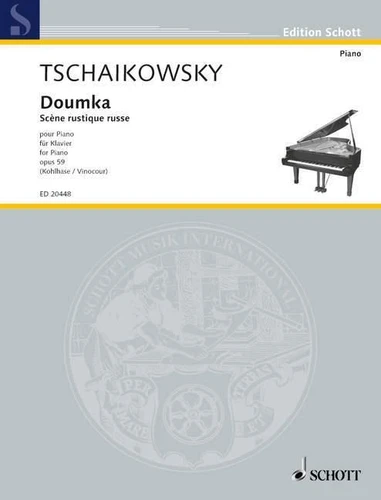
Doumka. Scène rustique russe. op. 59. piano.
Par : Formats :
- Paiement en ligne :
- Livraison à domicile ou en point Mondial Relay estimée à partir du 1 avrilCet article sera commandé chez un fournisseur et vous sera envoyé 10 jours après la date de votre commande.
- Retrait Click and Collect en magasin gratuit
- Livraison à domicile ou en point Mondial Relay estimée à partir du 1 avril
- Réservation en ligne avec paiement en magasin :
- Indisponible pour réserver et payer en magasin
- Nombre de pages18
- Poids0.106 kg
- Dimensions23,1 cm × 30,3 cm × 0,0 cm
- ISBN979-0-001-15374-4
- EAN9790001153744
- Date de parution01/01/2009
- CollectionPIANO
- ÉditeurSchott
- EditeurThomas Kohlhase
Résumé
Tchaikovsky composed the Russian rural scene 'Dumka' in just a few days in late February 1886. 'Dumka' is originally the name of an epic and historical South West Slavic folk song of a melancholy nature. In Tchaikovsky's Op. 59, the elegiac andante cantabile forms the framework of the fast middle section in which brief formulaic thoughts, newly varied and increasing in virtuosic intensity, display fireworks of pianistic brilliance.
Being his only 'Morceau de Concert', this piece occupies a special place among the piano works of Tchaikovsky. As a pianist who rarely gave concerts and occasionally complained about the lack of interest from the keyboard titans of his time (Franz Liszt, Hans von Bülow and the brothers Anton and Nikolaj Rubinstein) in his music. Tchaikovsky certainly regarded the piece as a chance to make his music known outside of Russia.
So the French subtitle of the piece may rather be understood as a concession to the French audience. Instrumentation : piano op. 59
Being his only 'Morceau de Concert', this piece occupies a special place among the piano works of Tchaikovsky. As a pianist who rarely gave concerts and occasionally complained about the lack of interest from the keyboard titans of his time (Franz Liszt, Hans von Bülow and the brothers Anton and Nikolaj Rubinstein) in his music. Tchaikovsky certainly regarded the piece as a chance to make his music known outside of Russia.
So the French subtitle of the piece may rather be understood as a concession to the French audience. Instrumentation : piano op. 59
L'éditeur en parle
Die 'ländliche russische Szene' Dumka komponierte Tschaikowsky in nur wenigen Tagen Ende Februar 1886. "Dumka" bezeichnet ursprünglich ein südwestslawisches episch-historisches Volkslied melancholischen Charakters. In Tschaikowskys op. 59 bildet das elegische Andante cantabile den Rahmen für einen schnellen Mittelteil. In diesem entzünden kurze, formelhafte Gedanken, immer neu variiert und virtuos gesteigert, ein Feuerwerk pianistischer Brillanz.
Im Klavierwerk Tschaikowskys nimmt das Stück als sein einziges "Morceau de Concert" einen besonderen Platz ein. Tschaikowsky, der bekanntlich kein konzertierender Pianist war, und gelegentlich das mangelnde Interesse der Tasten-Titanen seiner Zeit (Franz Liszt, Hans von Bülow oder die Brüder Anton und Nikolaj Rubinstein) an seiner Musik beklagte, sah in dem Stück sicher auch eine Möglichkeit, seine Musik in einem Land außerhalb seiner Heimat bekannt zu machen.
Besetzung : piano op. 59
Im Klavierwerk Tschaikowskys nimmt das Stück als sein einziges "Morceau de Concert" einen besonderen Platz ein. Tschaikowsky, der bekanntlich kein konzertierender Pianist war, und gelegentlich das mangelnde Interesse der Tasten-Titanen seiner Zeit (Franz Liszt, Hans von Bülow oder die Brüder Anton und Nikolaj Rubinstein) an seiner Musik beklagte, sah in dem Stück sicher auch eine Möglichkeit, seine Musik in einem Land außerhalb seiner Heimat bekannt zu machen.
Besetzung : piano op. 59
A propos de Piotr i. Tchaikovski
Vous aimerez aussi
3,50 €
Le roman de Murat
Grand Format
22,90 €
Jul. Petit dictionnaire
Grand Format
14,90 €

Guide de la parfaite Swiftie
Grand Format
12,95 €